The Tobacconists
LOS ESTANCOS: AGRICULTURAL LANDSCAPE AND RURAL MEMORY IN THE SURROUNDINGS OF PUERTO DEL ROSARIO
Los Estancos is located in the plains of El Viso, 260 meters above sea level and 6 kilometers from Puerto del Rosario. The very name of the place offers a clue about its past. The term “estanco” historically referred to a good or activity subject to monopoly or control -such as tobacco or salt-, although in the rural context of Majorero it has also been linked to closed or delimited spaces. In any case, the toponym reflects a form of territorial organization linked to the control of resources, something essential on an island where water and arable land were scarce and strategic goods.
The settlement was consolidated as an agricultural and livestock center dependent, for centuries, on the parish of Tetir. The local economy was based on the cultivation of dry cereals -especially wheat and barley in favorable years- and on goat breeding, the mainstay of the subsistence of the Majoreros.
WATER AS THE AXIS OF THE LANDSCAPE
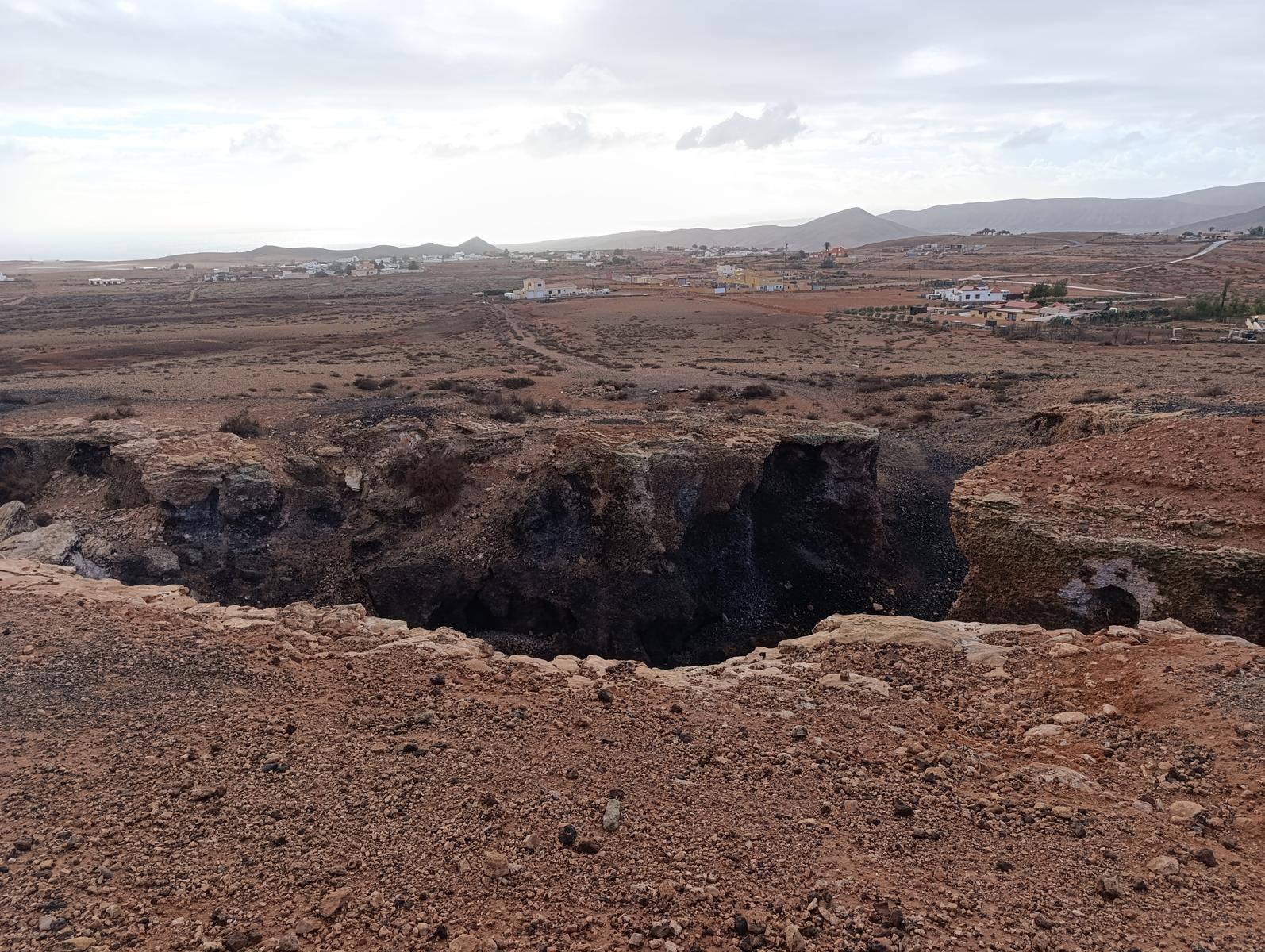
One of the most relevant elements of the landscape of Los Estancos is its link to the traditional use of water. As in other inland pagos, the system of gavias made it possible to channel and retain the runoff produced by occasional rains, transforming arid land into productive plots. These ingenious hydraulic systems, built with earth and stone, constitute today a valuable ethnographic heritage that explains the adaptation capacity of the Majorero population.
The agricultural landscape is complemented by dry stone walls that delimit properties and protect crops from the wind, as well as threshing floors.
ARCHITECTURE AND HISTORICAL EVOLUTION
The architecture of Los Estancos responds to the rural majorero pattern: earthen houses of masonry, whitewashed, of simple and functional lines of yesteryear that are mixed with more modern architecture. In some cases, the houses are articulated in small family groups, a reflection of the social organization based on large domestic units and neighborhood cooperation.
During the nineteenth and early twentieth centuries, agricultural crises, recurrent droughts and limited soil productivity drove migration processes that also affected this payment. As occurred in large areas of the interior of Fuerteventura, the population decreased or remained stable, without experiencing large growth.
In 1925, with the administrative reorganization that eliminated former rural municipalities such as Tetir, Los Estancos became part of the municipality of Puerto Cabras, historical name of the current Puerto del Rosario, where it became the second airfield of the island.
THE AERODROME OF LOS ESTANCOS (1951-1969): THE SECOND AIRPORT OF FUERTEVENTURA
Origin and context: the relay of Tefía
The aerodrome of Los Estancos was born to replace the primitive aerodrome of Tefía, the first of the island, which was obsolete and far from the capital. At the beginning of the 1950s, the Island Council of Fuerteventura, showing great interest in improving communications, negotiated the construction of a new aerodrome with the Air Ministry. The island institution ceded the necessary land, located in the area of Los Estancos, a short distance from the then capital, Puerto de Cabras (a name it kept until 1956, when it was renamed Puerto del Rosario).
Chronology and key technical data
– Construction and inauguration: The Air Ministry authorized the construction in May 1950. The soldiers of the Tefía barracks were in charge of preparing the land. The aerodrome became operational in 1951, although during a brief initial period the airplanes alternated their flights between Los Estancos and Tefía depending on the wind direction.
– Period of activity: Its operating life lasted from 1951 to 1969.
– The main runway: The original runway, designated with the marking 03/21, was 1,350 meters long and was made of compacted soil (not asphalted). The cost of these initial works amounted to 70,000 pesetas of the time.
– Road singularity: The runway crossed perpendicularly the road that linked Puerto del Rosario with Tetir. This required a peculiar security system: a soldier or airport personnel operated barriers on both sides of the runway to stop road traffic during landings and takeoffs, being warned from the control tower with acoustic signals (a whistle) or visual signals (flags).
Infrastructure and evolution
– First facilities: In its beginnings, the “terminal” was very modest. Two wooden barracks from the dismantled Tefía aerodrome were reused to handle passenger traffic. These were later replaced by a building fitted out as a depot.
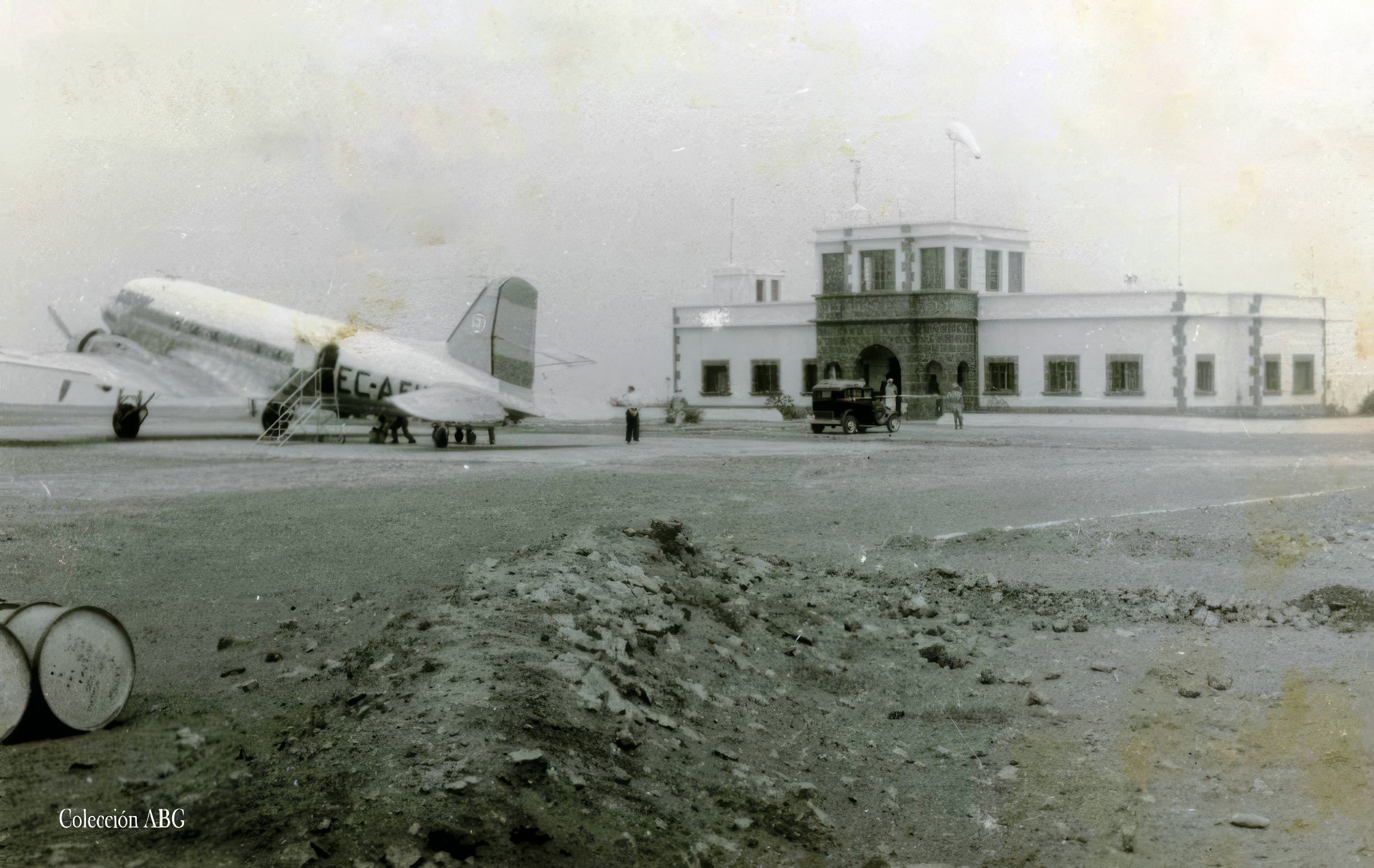
– The terminal building: The great improvement came between 1953 and 1954 with the construction of a proper terminal building, which also included a control tower. This construction was so significant that, in 1954, Los Estancos airport was one of the few facilities on the entire island that had electricity and running water.
– Second runway: A second runway, 12/30, was inaugurated in 1955 to take better advantage of crosswinds and reduce flight cancellations.
Operations and decline
– First commercial flight: The first civil aircraft to land at Los Estancos (1951) was an emblematic twin-engine Douglas DC-3 of the Iberia company, with registration EC-ABC. This aircraft operated the route Las Palmas – Fuerteventura – Lanzarote and return with a frequency of only once a week.
– Rise and fall: Over time, the limitations of the dirt runway (poor maintenance, dust) and the increase in air traffic took their toll. In 1966, a record twelve operations in a single day was reached, which showed that Los Estancos had become too small. Pilots frequently complained about the difficulties in landing, and, although the runway was filled and marked out, it was never asphalted. The continuous gusty winds in the area and the need to attract the growing tourism with a modern airport sealed its fate.
Closing and legacy
– Definitive closure: Los Estancos airport was officially closed on September 14, 1969. The following day, September 15, 1969, the new international airport of El Matorral (currently Fuerteventura Airport) was inaugurated, which solved the problems of its predecessor.
– Posthumous success: Anecdotally, in 1971, during refurbishment work at El Matorral, Los Estancos was temporarily reopened to accommodate flights.
– News: Far from disappearing, the facilities of Los Estancos have been preserved. The old terminal and its structures are still standing. Currently, the site houses the Insular Center for Coordination of Security and Emergencies (CECOPIN) of the Cabildo of Fuerteventura, giving a new service to the island. The old runway, although split by the road, is still visible and is a silent testimony of the beginnings of commercial aviation majorera.