



Tesjuate
Tesjuate: livestock tradition, tanneries and rural memory in the heart of the Río Cabras gorge
An approach to the long history of a majorero village
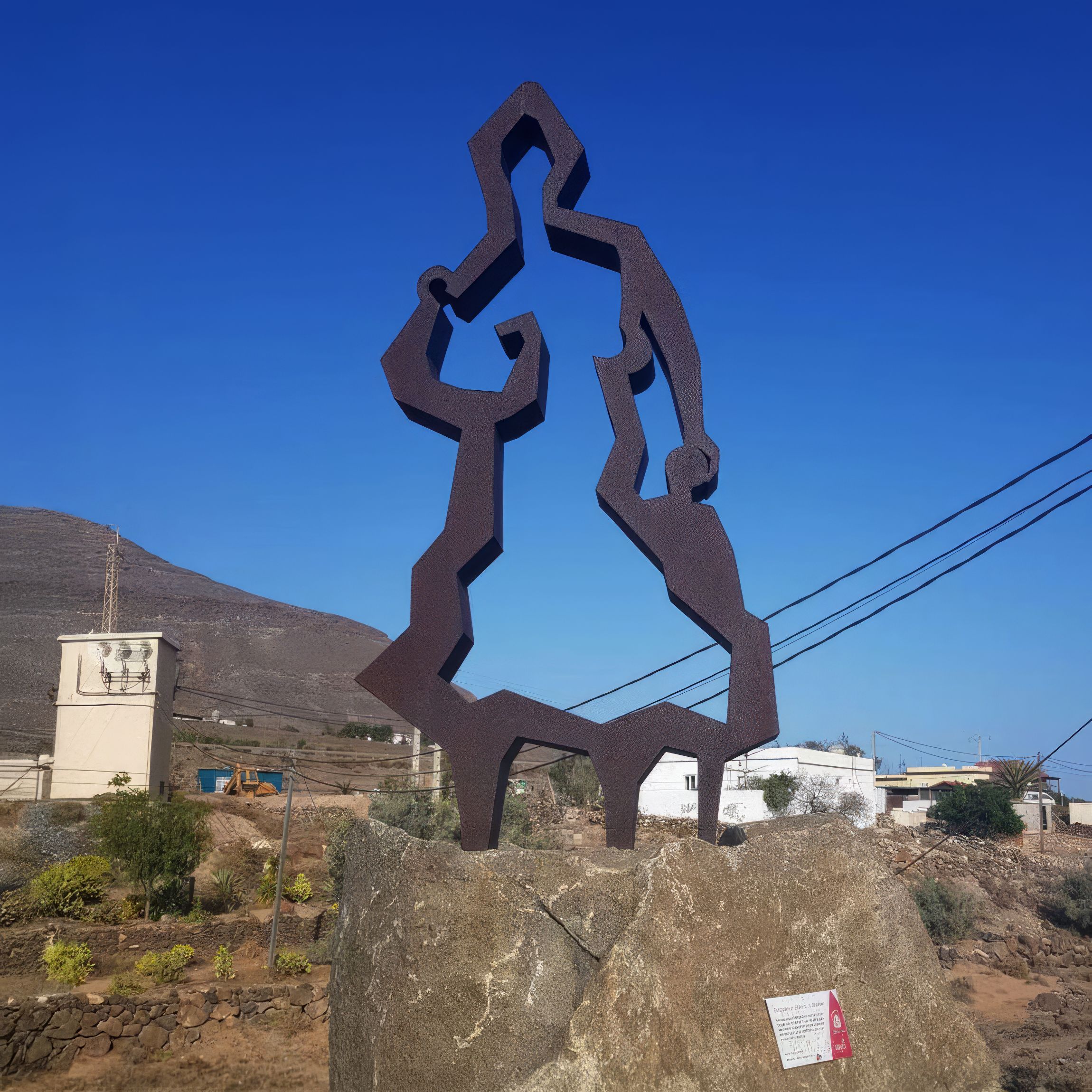
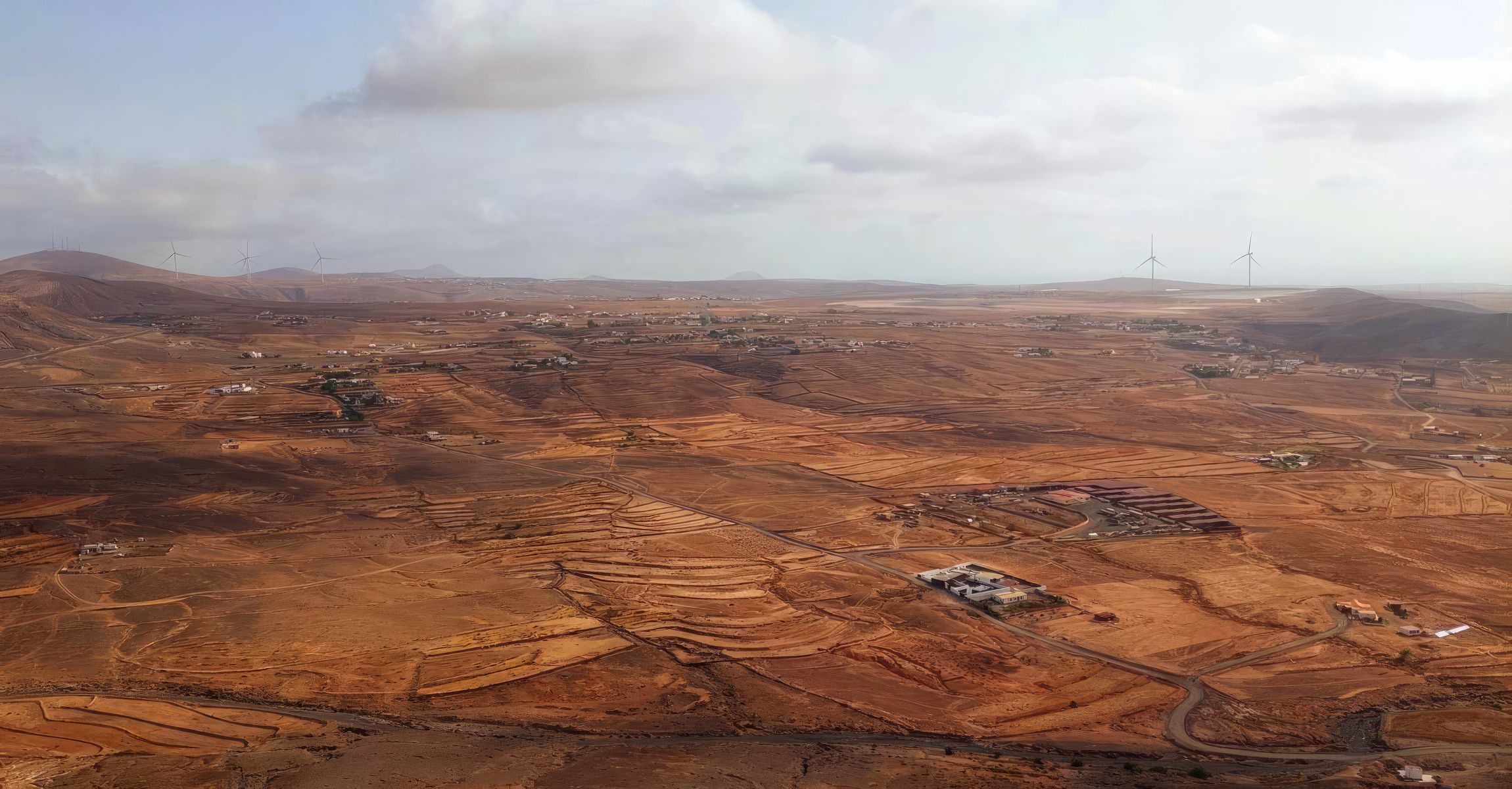
Tesjuate is a small hamlet in the municipality of Puerto del Rosario that sits in the environment of the fertile lands formed by the passage of the ravine of Rio Cabras, the longest of Fuerteventura, with its almost 16 kilometers long. This enclave, traditionally linked to goat farming, the collection of barrilla and cereal agriculture -especially barley-, represents a living testimony of human adaptation to an arid environment but privileged by the permanent presence of water.
The Río Cabras ravine: a vital axis since prehistoric times.
The ravine of Rio Cabras born in the foothills of the mountain of Tao and flows between Playa Blanca and the airport, through the villages of Casillas del Angel and Tesjuate. It is the longest of all the ravine of Fuerteventura and one of the few places on the island where water flows constantly throughout the year.
Importance in pre-Hispanic times
Due to its perennial character, the ravine became from pre-Hispanic times a fundamental enclave for the ancient inhabitants of the island, the mahos. In its surroundings there are important aboriginal settlements, such as the Lomos de Lesques or the one located in a cleaver on the right side of the ravine. There are also rock engravings on various panels, both on the walls and near the mouth, testimony to the presence and symbolic significance of this place for the indigenous communities.
The fountain of Río Cabras: a royal property
After the conquest and repopulation of Fuerteventura by new settlers in the sixteenth century, the sources of Rio Cabras remained fundamental to the life of the island. The largest of them became a public fountain for general use or royalty, which had to be cleaned periodically by the residents of Fuerteventura.
The agreements of the island’s Cabildo include numerous provisions related to this source, which demonstrates its strategic importance:
- March 20, 1606: it was agreed that all the neighbors of the island would clean the fountain of Río Cabras on April 13, under penalty of 4 reales to whoever failed to do so.
- March 17, 1610: it was forbidden to wash clothes in the town’s fountains, explicitly including that of Río Cabras, to avoid contamination and deterioration.
- June 28, 1613: It was denounced that the neighbors were giving water to their camels and sheep in the fountains of Río Cabras and Esquinzo, against the immemorial custom and the ordinances of the island, causing great damage to the cows, mares and goats. Progressive fines were established: 12 reales the first time, double the second time and 1,000 maravedíes the third time.
The source became so abundant that in 1615 a hydraulic infrastructure was built that included:
- A watering trough or box for camels and sheep
- Another watering place for cows, mares and goats
- A laundry area
- An area for collecting water for human consumption
The agreement specified that the spring was “realenga and common to all”, and that it had a part designated for goats (the box next to the cliff) and for camel cattle (the stone box), reserving the rest for cows, mares and other livestock, excluding pigs.
Over time, the Río Cabras spring ceased to be used and its boxes were dismantled. Currently, the spring has no associated construction and is surrounded by reeds, rushes and lush reed beds.
The Río Cabras Ravine Dam
A couple of kilometers from the mouth of the ravine is a small dam built in the 60s of the twentieth century, with an original capacity to store about 1.2 cubic hectometers of water. This reservoir was soon clogged by lands washed away by torrential rains, but its presence testifies to modern attempts to harness the water resources of this exceptional ravine.
Current ecological value
At present, the Río Cabras ravine is home to an ecosystem of great value. The numerous pools that form in its bed are breeding habitat for several species of waterfowl, and are also used by wintering and passage birds. The walls of the ravine offer breeding sites for birds of prey.
In the riverbed breed pairs of little plovers, great sandpipers, little sandpipers and cinnamon shelducks. On the walls nest pairs of buzzards, owls, rock doves and single-colored swifts. It is not difficult to observe blue tits and black-headed warblers among the tamaracks.
The tanneries of Tesjuate: an industry linked to water
Because the Río Cabras ravine was the most plentiful on the island, several tanneries, facilities dedicated to the tanning of skins, were established in its vicinity. This industry, which required abundant water for the cleaning and treatment of the skins, found in Tesjuate and its surroundings the ideal conditions for its development.
The presence of these tanneries adds another layer to the productive identity of Tesjuate, which combined goat farming (source of the skins), cereal agriculture and the collection of barrilla (used for the production of soda, necessary in tanning and other industrial processes).
Toponymy: the origin of the name Tesjuate
The name of this locality has never been clear since its beginnings. According to Marcial Morera, professor of Spanish Philology at the University of La Laguna, Tejuates comes from the Majorero form Tiggaten, a word of Amazigh (Berber) origin composed of the feminine plural article “ti” and the plural noun “gatten”, meaning “goats”.
The hamlet has historically been known as Teguate or Tejuate, also ending in “s”. The current name of Tesjuate was adopted by an error of the MOP (Ministry of Public Works) in the signage, consolidating since then.
The first documented references to “Teguate” appear in French cartographic maps from the second half of the 18th century. In the report made in 1772 for the General Archive of Simancas, this hamlet is named as Tejuacén, noting that at that time it had 11 neighbors.
Religious and parish consolidation
In 1787, the independent parish beneficiaries of Fuerteventura began. In that same year, the parish of Tuineje became an independent Beneficiary, at the same time as the parish of Antigua and Casillas del Ángel, on which Tesjuate depended ecclesiastically.
Emigration to America and the Francisco Morales scam
The harsh living conditions of Fuerteventura, coupled with a sharp decline in the economy, made many majoreros emigrate to the Americas in the first half of the nineteenth century. The best known of this time were Fray Andresito (native of La Ampuyenta) and Doctor Mena (also from La Ampuyenta), but also fled Tesjuate families who sold their land to try to survive away from where they were born.
In the decade of the 30’s of the XIX century, Francisco Morales appeared in Fuerteventura, who organized clandestine expeditions in the brigantine “Gloria” to take hundreds of majoreros and conejeros to the Republic of the Río de la Plata. Morales kept the possessions of these people as payment for the passage to Spanish America. Many majoreros, some from Tesjuate, were left without boarding and without land, since Francisco Morales had sold them, as attested by the different reports and documents of the Historical Archive.
Romantic travelers and the gaze of Olivia Stone
In the second half of the nineteenth century increased the arrival in Fuerteventura of romantic travelers, mainly from England and France. These travelers left numerous writings related to the way of life of the island. Among the most prominent are George Glas, José de Viera y Clavijo, Sabin Berthelot, Barker Webb, Olivia Stone and René Verneau.
Olivia Stone wrote in 1884 this description of Tesjuate (which she called Teguate):
“At our feet, as our camel gently moved on, there was a brilliant carpet of purple, white, yellow and orange flowers; patches of delicate, creamy daisies, with gold centers (…) “a harmonious whole”. In a low-lying riverbed, we were surprised to see in this thirsty water seeping along, the Rio Cabras; yet it is, alas, bitter.
We began to meet the peasants as we made our way across the plateau to some houses. One man, driving a donkey in front of him, was wearing blue striped pants and a dark blue jacket. We walked through the ravine below Teguate covered with mud huts.
A solitary palm tree adorns the village. There are three wells, whose water, although slightly brackish, is used.
Two round, cemented pillars stand on one of the riverbanks; a cross stands on each.
The houses of Teguate go down to the side of the ravine, until close to the larger and more important houses of Casillas del Angel. This village is barely discernible at close range. The low, one-story houses are built entirely of mud, or else of loose stones and mud, using the surrounding earth for this purpose.”
Tesjuate’s crosses: tradition and memory
The crosses referred to by Olivia Stone are the ones next to the Unitarian School. According to popular tradition, the crosses were erected in memory of a priest and an altar boy who, being called to give last rites to an elderly man in the area, died drowned at the site when they were swept away by the waters of the ravine when they tried to cross it on a day of torrential rains.
The inhabitants of Tesjuate have recovered the custom of decorating the crosses with flowers on the eve of May 3, the Day of the Cross. This tradition, deeply rooted in the community, connects the historical memory of the town with the festive and religious calendar.
The La Esperanza company and water canalization
In 1894 the company La Esperanza was created to take advantage of the water from the Río Cabras ravine, which spontaneously gushed to the surface at the height of Tesjuate. From there, the water was channeled through pipes to the then Puerto Cabras (now Puerto del Rosario), previously passing through some farms.
This ingenious canalization work was divided into two branches:
- One went as far as the church square to water the trees.
- Another reached a small grove of tarajales that had been created below the old cemetery.
This initiative demonstrates the strategic importance of Tesjuate’s waters for the supply of the island’s capital.
The farmhouse today: architecture and way of life
The hamlet of Tesjuate maintains the stamp of the traditional majorero villages. The low single-storey houses, built with stone and mud, go along the ravine. A solitary palm tree, already mentioned by Olivia Stone in 1884, is still an emblematic element of the village landscape.
During a tour of Tesjuate you can enjoy the tranquility that gives the majorera land in these parts. It is still possible to meet shepherds like Juan Pérez, who goes down the ravine with his goats and his faithful bardino, keeping alive an ancient tradition.
The festivities of Tesjuate
Tesjuate celebrates its festivities on the first Sunday of May, a date that marks the beginning of spring and coincides with the tradition of the Day of the Cross. These festivities bring together neighbors and visitors around religious, cultural and recreational activities that reinforce the community identity of the town.
Administrative assignment
Tesjuate belonged to the extinct municipality of Casillas del Ángel until 1926, when it was added to the municipality of Puerto de Cabras, today Puerto del Rosario, after the administrative reorganization that involved the dissolution of the municipality of Casillas del Ángel.
Historical continuity and territorial memory
Tesjuate represents an exceptional example of historical continuity in Fuerteventura. The presence of water in the ravine of Rio Cabras has been the determining factor that has allowed human settlement in this enclave since pre-Hispanic times to the present day.
The aboriginal vestiges of Los Lomos de Lesques and the cave engravings testify to the importance of the place for the mahos. The springs of Río Cabras, managed as a royal property for centuries, were the object of a sophisticated regulation that demonstrates the strategic value of water on an arid island. The tanneries, cereal agriculture and goat farming shaped a diversified economy adapted to the environment.
Emigration to America, with its lights and shadows – including the tragic swindle of Francisco Morales – connects Tesjuate with the broader history of the Canarian diaspora. Romantic travelers, especially Olivia Stone, left invaluable testimony of the landscape and people of Tesjuate in the 19th century. And living traditions, such as the enrame de las cruces on May 3, maintain the collective memory and community roots.
In its humble hamlet, in its centenary crosses, in its ravine where water still flows, in the ponds that shelter birds, in the solitary palm tree and in the memory of its people, Tesjuate continues to write its history. A story that began long before Europeans set foot on the island and that, transformed but not extinct, is still alive in the heart of the longest and most generous ravine of Fuerteventura.