



Llanos de la Concepción
LLANOS DE LA CONCEPCIÓN: ABORIGINAL TERRITORY, LORDSHIP AND RURAL MEMORY AT THE HEART OF FUERTEVENTURA
Llanos de la Concepción is today a town integrated in the municipality of Puerto del Rosario, but its history is rooted in a much older past than the modern municipal configuration itself. The territory it occupies was part, since pre-European times, the living space of the ancient mahos, the name given to the aboriginal inhabitants of Fuerteventura before the Castilian-Norman conquest of the fifteenth century.
THE MAHO TERRITORY: ORGANIZATION AND USE OF SPACE
Before the arrival of the Europeans, the island was organized into two large territorial demarcations, Jandía and Maxorata. The current enclave of Llanos de la Concepción was located within the former Maxorata, an area characterized by an eminently pastoral economy based mainly on goats.
The Mahos practiced a model of dispersed occupation of the territory, combining settlements in natural caves and dry stone structures. Their productive system included the use of seasonal pastures, gathering and agriculture limited by the arid climate. The communal use of large areas for grazing, documented after the conquest as “mancomunes”, has a clear antecedent in these aboriginal practices, which reveals a remarkable continuity in the collective management of the territory.
The current traditional livestock farming practices of the Majorero interior, especially the “apañadas”, conserve structural features inherited from this aboriginal model.
CONQUEST AND TRANSFORMATION OF THE TERRITORY
The conquest of the island was initiated in 1402 by Jean de Béthencourt and Gadifer de La Salle, integrating Fuerteventura into the sphere of the Crown of Castile under a feudal regime. After the incorporation of the Herrera and Ayala families into the seigniory, a redistribution of land and the implementation of a new administrative and religious model took place.
In this context, the island’s interior began to take shape, linked to livestock farming and subsistence agriculture adapted to the environment. The space now occupied by Llanos de la Concepción was articulated as an area of cultivation and transit, connected with other historical centers such as Betancuria -former capital of the island- and with the pagos dependent on the parish of Casillas del Ángel.
The toponym “Llanos” alludes to its open and relatively flat morphology within a landscape dominated by volcanic ridges and knives. The name “de la Concepción” is linked to the Marian devotion developed after the consolidation of Christianity on the island, especially from the seventeenth and eighteenth centuries.
The Diccionario geográfico-estadístico de España y sus posesiones de Ultramar, by Pascual Madoz, at the end of the XIX century described Llanos de la Concepción as a town belonging to the municipality of Casillas del Ángel: flat, chalky and shallow land, usually very stony, in terms that only opens the coulter (final part of the plow) a few inches, so their crops are very scarce unless it rains a lot.
For this reason, the inhabitants of this payment have dedicated themselves, after knowing the breeding of the cochineal, to the plantation of nopales, with which they have faced the great misery to which by the meanness of rains they are reduced. The soil that there is of cultivation, as we have said, is covered of stone to short depth, for whose reason the wooded one is not acclimatized if the stone is not broken and the feet are not introduced to a competent depth, facilitating them at the same time means of gathering some water in time of rains.
RELIGIOUS CONSOLIDATION AND PARISH ARTICULATION
In the 19th century, the territory was integrated into the parish jurisdiction of Casillas del Ángel, a nucleus that achieved notable ecclesiastical relevance in the north of the island. The construction of hermitages and places of worship in the different areas responded both to spiritual needs and to the desire to unite dispersed rural communities.
The hermitage dedicated to the Immaculate Conception in Los Llanos consolidated the identity of the settlement, becoming an axis of sociability and territorial reference. Religious festivities not only structured the liturgical calendar, but also articulated economic and social networks between the different settlements in the interior of the island.
The patron saint festivities in honor of the Immaculate Conception, held in mid-August, have been the main community event for centuries, strengthening neighborhood ties and keeping alive traditions such as processions, festivals and livestock gatherings.
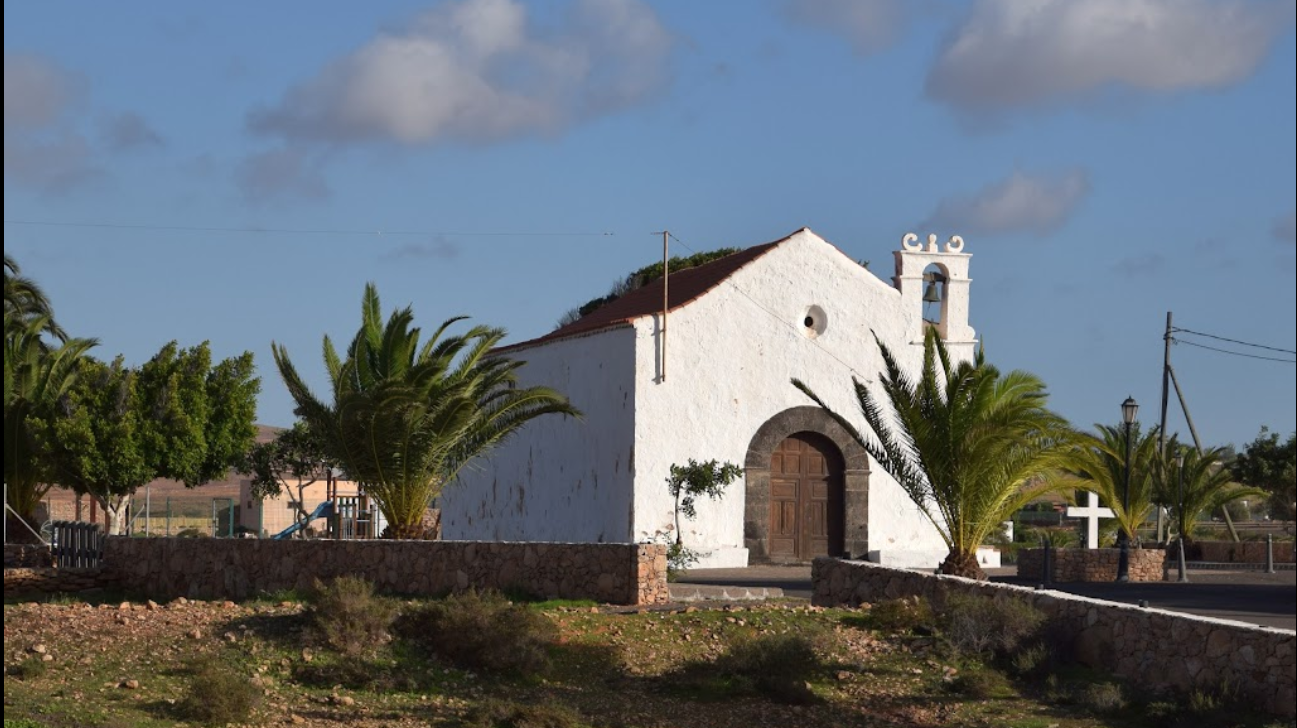
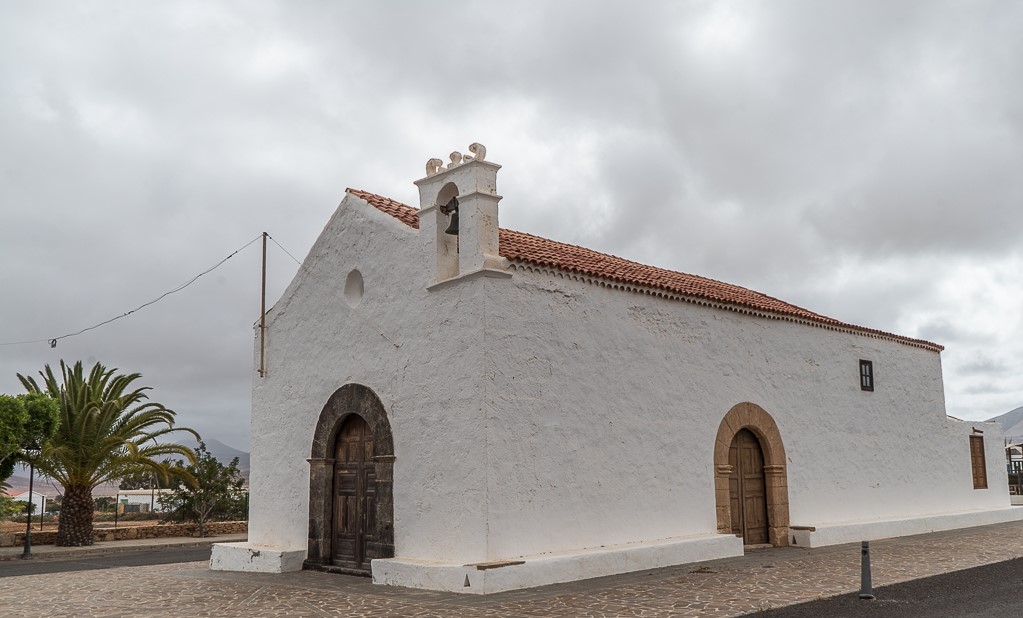
THE HERMITAGE OF OUR LADY OF THE CONCEPTION, REFLECTION OF A DEEP DEVOTION
Before its construction, this locality was known as Llanos del Otro Valle or Llanos de Santa Inés. The temple was built between 1784 and 1796 thanks to the collective effort of the neighbors, being D. Joseph de Armas the main promoter and guarantor of the work. The whole community committed itself by notarial deed to its endowment and maintenance, which reflects the deep devotion of the time. Finally, the chapel was blessed on March 20, 1798 and dedicated to the Immaculate Conception, a name that the town ended up adopting as well.
Architecturally, it is a sober example of the rural religious architecture of Majorca. It consists of a single nave with a three-sided wooden roof and tile roof. The main facade, facing west, is distinguished by a doorway topped by a semicircular arch and a small side belfry that houses the bell.
In its interior, of austere atmosphere, a small image of the Virgin of the Conception is conserved, carved in wood and polychrome, of about 30 centimeters of height. It is also remarkable an oil on canvas of the Pietà, framed with symbols of the Passion.
Today, the hermitage continues to be the nerve center of the social and spiritual life of the valley. Every August 15, and not on December 8 as usual, it celebrates its patron saint festivities in honor of the Immaculate Conception, a date authorized at the time by the renowned historian José de Viera y Clavijo.
Visiting this enclave allows you to discover the most authentic and quiet essence of Fuerteventura, connecting with its agricultural past and the faith of its people. The temple holds the distinction of Cultural Interest (BIC).
TRADITIONAL ECONOMY: GAVIAS, LIVESTOCK AND CLIMATE ADAPTATION
Like other villages in the interior of Fuerteventura, Llanos de la Concepción developed an economy based on the livestock-cereal binomial. The technique of the gavias, a traditional hydraulic system designed to capture and retain runoff water, allowed the cultivation of wheat, barley and legumes in an environment of low and irregular rainfall.
Goat breeding, a structural nucleus since aboriginal times, continued to be the main economic activity. Artisanal cheese production was part of a fundamental domestic economy.
TRADITIONAL ARCHITECTURE AND ETHNOGRAPHIC HERITAGE
Llanos de la Concepción preserves a valuable collection of traditional Majorcan architecture. The houses, whitewashed and of sober workmanship, respond to the rural Canarian domestic model, with mud and straw roofs (torta), stone floors and functional distributions adapted to the climate.
Next to the houses, there are ethnographic elements of great interest: tars, threshing floors, cisterns and dry stone walls that delimit the gullies. These elements make up a cultural landscape that testifies to the secular effort to inhabit and take advantage of a hostile environment.
Special mention should be made of the area known as Los Morros del Sol, a place where many meters of dry stone walls are preserved in excellent condition, silent testimony of the work of generations of farmers and shepherds who modeled the territory with their hands.
These constructions, built without any mortar, constitute an ethnographic heritage of the first order that reflects the traditional constructive wisdom and the organization of the agrarian space. The dry stone technique, declared Intangible Cultural Heritage by UNESCO, finds in Los Morros del Sol one of its most notable exponents in the municipality, deserving of protection and enhancement.
FROM HISTORICAL MUNICIPALITY TO ADMINISTRATIVE INTEGRATION
In the nineteenth century, Llanos de la Concepción was integrated into the large municipality of Casillas del Angel, which became one of the historic municipalities of the island. This municipality, created in 1837 during the liberal reorganization, covered an extensive territory in the north of Fuerteventura.
However, in 1926, the administrative reorganization of the island led to the dissolution of the municipality and its incorporation into what was then called Puerto Cabras, now Puerto del Rosario. This decision responded to the need to strengthen the incipient capital nucleus, which already concentrated administrative and port functions.
Since then, Llanos de la Concepción has been part of the capital municipality, although it has preserved a rural identity marked by its agricultural landscape, its traditional whitewashed stone architecture and its memory of livestock farming.
The valorization of this heritage, both tangible and intangible, is not only a question of identity, but also an opportunity to build a sustainable future that integrates the legacy of the past with the needs of the present. In its whitewashed streets, in its gavias, in its flocks, in the walls of Los Morros del Sol and in the memory of its people, Llanos de la Concepción continues to write its history, that long history that began long before the very name of the town existed.
