



Town of Las Parcelas
Las Parcelas (Colonia Rural García Escámez): the last village in the municipality of Puerto del Rosario.
An approach to the history of the most recent agricultural settlement of Fuerteventura.
Las Parcelas, officially called Colonia Rural García Escámez, is the most recent village in the municipality of Puerto del Rosario. Located on the board of Las Escuderas, in the surroundings of the ravine of Los Molinos, this agricultural colony represents a unique experiment of settlement promoted by the Economic Command of the Canary Islands in the 1940s, with the aim of “greening the desert” and promote self-sufficiency through family farming.
The territory: the commonwealth of Puerto del Rosario and the estate of Las Salinas
Las Parcelas sits on land that was part of the commonwealth of Puerto del Rosario, specifically in the part of the commonwealth called Las Salinas. This designation is no coincidence, as it reflects the history of the use of these soils, traditionally linked to the extraction of salt and the communal uses of grazing and harvesting.
The mancomunes were spaces of collective use of the territory, heirs of communal management practices dating back to aboriginal times. After the conquest, these formulas were maintained and regulated, configuring extensive areas where the neighbors of the different villages could graze their cattle, collect barrilla or obtain other resources.
The commonwealth of Puerto del Rosario was divided into two main parts:
- Las Salinas: the portion where Las Parcelas is located, whose name alludes to the traditional salt activity on the nearby coast.
- Jarugo: the other large extension of the commonwealth, located in the vicinity.
The use of common lands for the creation of the settlement was not free of complexities. The Las Parcelas project used common land together with land contributed by some families, on the condition that they would be granted the use of the dam on an equal footing with the rest of the settlers.
Background: the “Settlement of Los Molinos”.
The project that would give rise to Las Parcelas was known administratively in its beginnings as “Asentamiento de Los Molinos”, in reference to the nearest town on the west coast, Puertito de Los Molinos, following the usual practice in Fuerteventura of giving shelter in the nomenclature to new population centers.
The area chosen was the board of Las Escuderas, a space located in the vicinity of the ravine of Los Molinos, where a dam was being built to irrigate the cultivable plots. The idea cherished by the military authorities of the time was to take advantage of the waters of this hydraulic infrastructure to convert an arid territory into productive farmland.
The context: the Economic Command of the Canary Islands (1941-1947)
The Economic Command of the Canary Islands was an organization created in the context of the Spanish post-war period and the Second World War, with the aim of promoting the economic development of the archipelago and ensure food self-sufficiency at a time of blockade and shortages. In Fuerteventura, this organization promoted several works and infrastructures, among which the following stand out:
- The Tefía aerodrome
- Los Molinos Dam
- The settlement of Las Parcelas
- Other actions in the island’s capital, such as the Barriada de Nuestra Señora del Carmen, the Barriada Militar and the Colegio General Primo de Rivera in El Charco.
The architectural project by Miguel Martín Fernández de la Torre
The initial architectural project was due to the architect Miguel Martin Fernandez de la Torre, a relevant figure of the Canarian architecture of the twentieth century who designed other unique buildings in Fuerteventura, such as the Government Delegation in the 1950s.
For Las Parcelas, the 1945 project contemplated different functional units:
- Two types of houses for settler housing
- Uniquely styled buildings for schools
- Social house
- Hermitage
The dream image for the newest town in the municipality of Puerto del Rosario had its own signature. Its design would deserve to find shelter in the study of post-war architecture, particularly that carried out by the Economic Command of the Canary Islands in Fuerteventura, both for its initial aesthetics and for the strategy of creating family agricultural production units.
However, what was finally built or is preserved today “has nothing to do with the aesthetic lines followed by the Gran Canarian architect. The current hermitage, of relatively recent stage, is not the one designed by Martín Fernández de la Torre, whose original project for the temple of the settlement responded to a very different aesthetic conception.
Start-up: land, water and settlers
Acquisition of land
For the creation of the settlement were used:
- Communal land of the commonwealth of Puerto del Rosario, specifically the part called Las Salinas.
- Soils contributed by some families, on the condition that they would be granted the use of the dam on an equal footing with the rest of the settlers.
The land thus “amassed” was distributed into lots that were ploughed and put into exploitation. Some lots had houses, others did not.
The cast
The project included the distribution of land and water to a total of:
- 23 landholders
- 7 owners
A total of 30 poor families benefited from this settlement, receiving housing and arable land.
Water wealth: a “blessed town”.
Las Parcelas was known as “Pueblo Bendecido” (Blessed Village) due to the richness of water in the area, an exceptional circumstance in the arid Fuerteventura. This abundance of water, associated with the waters of the Los Molinos ravine dam, allowed the intensive cultivation of tomatoes and vegetables, differentiating this settlement from the general aridity of the island.
The high water productivity of the area was a determining factor for the location of the settlement and for its initial success as an agricultural experience.
Inauguration and transfer to the municipality
In 1946 the settlement was inaugurated, which was ceded to the municipality of the then Puerto de Cabras (now Puerto del Rosario). A plaque commemorating the inauguration of the village, located in one of the buildings of the hamlet, recalls this founding moment.
The official name of “Colonia Rural García Escámez” responds to the honor with which the Municipal Corporation wanted to honor the first captain general who exercised the Economic Command of the Canary Islands, once the rural colony was ceded to the City Council of Puerto de Cabras.
The hermitage and the dedication to St. Andrew
The dedication of the temple of Las Parcelas responds to a decision taken by the settlers themselves in the late 1950s, recalling that in Fuerteventura, San Andrés was already the patron saint of agriculture since 1609.
Every year, the people continue to procession San Andrés in Colonia Rural García Escámez, keeping alive a religious tradition that connects this modern settlement with the island’s long agricultural history.
The popular name: “Las Parcelas”.
Although it was officially called Colonia Rural García Escámez, the residents of the village have always kept the name “Las Parcelas”, which is how it is still popularly known today. This name reflects the essence of the settlement: a group of cultivable plots of land distributed among farming families.
Location and landscape
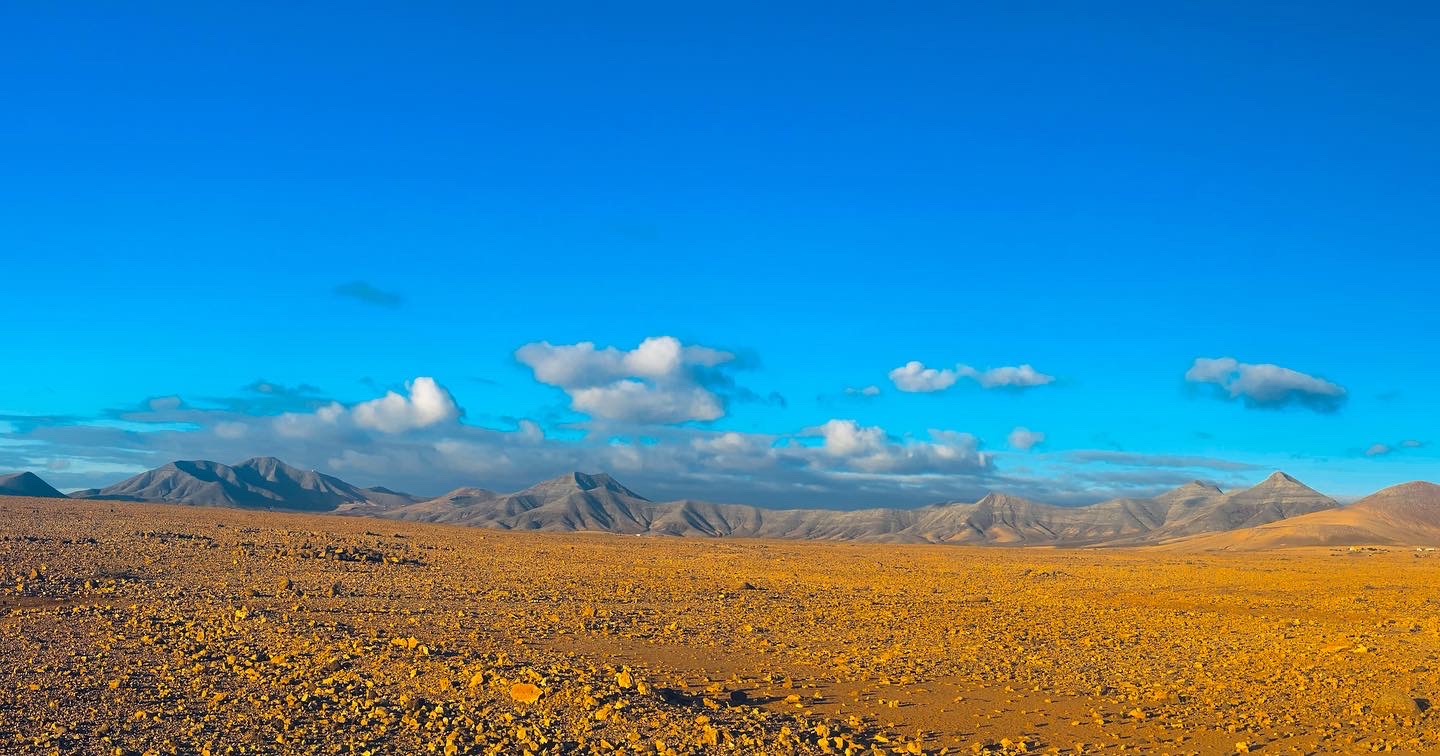
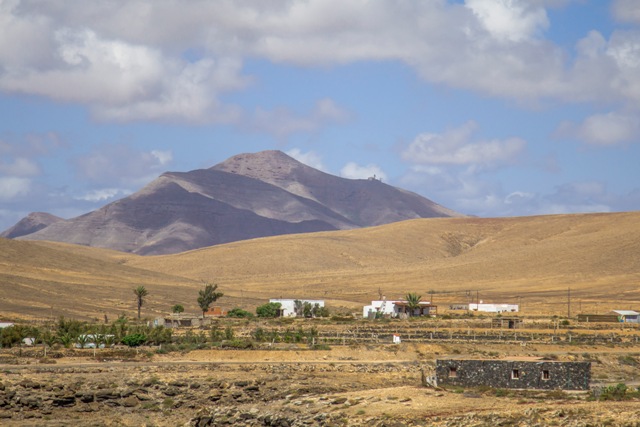
Las Parcelas sits on the board of Las Escuderas, in the surroundings of the ravine of Los Molinos, near the dam that made possible the irrigation of the land. Its location, in the interior of the municipality of Puerto del Rosario, places it in a transition zone between the town of Tefía and the western coast where the Puertito de Los Molinos is located.
The landscape surrounding Las Parcelas is marked by:
- The farmland that still remains in the area
- Los Molinos dam, testimony of the hydraulic infrastructure that made settlement possible
- The volcanic formations and the characteristic boards of the majorero interior
- The proximity to the Los Molinos ravine channel
Historical evolution: boom and bust
The period of splendor
After its foundation in 1947, Las Parcelas experienced a period of intense agricultural activity, benefiting from the high water productivity of the area. The cultivation of tomatoes for export, boosted since 1950 and during the 1960s, occupied the Los Opares and Los Molinos fields, irrigated with water from the dam.
This was an important source of employment and economic activity in the region, which allowed the families settled in Las Parcelas to develop an exceptional irrigated agriculture in the Majorero context.
The decline
Over time, as happened in other agricultural centers of Fuerteventura, Las Parcelas suffered a progressive demographic and productive decline. The rural exodus to the capital and the tourist resorts in the south, coupled with the crisis in the traditional agricultural sector, reduced the population and economic activity of the settlement.
At the present time
Today, Las Parcelas is a quiet rural area within the municipality of Puerto del Rosario. Although agricultural activity has declined considerably, the village maintains its identity as an agricultural and livestock settlement and preserves the memory of its unique origins.
An experiment with lights and shadows
The Las Parcelas project represented an attempt by the administration, through the Mando Económico de Canarias, to improve the local economy by settling families in the interior of the island, combining the granting of land and housing with the use of the water resources of the Los Molinos dam.
However, the project suffered from a fundamental shortcoming, as critics point out: “It is a pity that they forgot about the market to place the surpluses produced there”. This limitation in the commercialization of the products was one of the factors that conditioned the long-term viability of the experiment.
Despite its difficulties, Las Parcelas remains as a living testimony of the agricultural colonization policy promoted in the Spanish post-war period and as a unique example in Fuerteventura of a settlement planned by the Economic Command of the Canary Islands.
The heritage value of Las Parcelas
Las Parcelas is a unique element of the historical and cultural heritage of the municipality of Puerto del Rosario for several reasons:
- It is the most recent village of the municipality, founded in 1947, which differentiates it from the nuclei of historical origin such as Tefía, La Ampuyenta or Tesjuate.
- It is located on the common land of Puerto del Rosario, specifically in the part called Las Salinas, which links it to the tradition of communal management of the territory inherited from the aboriginal era.
- It represents a planned experiment in agricultural colonization, promoted by the institutions in a specific historical context: the post-war period and the autarchy.
- It is linked to the figure of Miguel Martín Fernández de la Torre, an outstanding 20th century Canarian architect, although his original project was never fully executed.
- It is part of the set of actions of the Canary Islands Economic Command in Fuerteventura, together with the Los Molinos dam, the Tefía aerodrome and the works in the capital.
- It preserves the memory of a way of life based on family farming, land sharing and community water use.
- It maintains living traditions, such as the procession of San Andrés every year, which connect the settlement with the agricultural history of the island.
Toponymy: a plural name
The town is known by several names that reflect different stages and aspects of its history:
- “Las Parcelas”: the popular name, maintained by the neighbors, which alludes to the distribution of the land in cultivable lots.
- “Colonia Rural García Escámez”: the official name, in honor of the first captain general of the Economic Command of the Canary Islands.
- “Settlement of Los Molinos”: the initial administrative name, referring to the nearest coastal village.
- “Pueblo Bendecido”: the affectionate nickname that reflects the water richness of the area, exceptional in the arid Fuerteventura.
Historical continuity and territorial memory
Las Parcelas represents a unique chapter in the long history of the settlement of Fuerteventura. Unlike traditional rural settlements such as Tefía, Tesjuate or La Ampuyenta, whose origin dates back to aboriginal times or to the centuries after the conquest, Las Parcelas is a planned settlement of the twentieth century, the result of an institutional intervention in a very specific historical context.
Its location on the mancomún of Puerto del Rosario, in the part called Las Salinas, links it, however, to the forms of collective management of the territory that have their roots in the pre-Hispanic past. The mancomunes were for centuries the support of the majorera livestock and agricultural economy, and although Las Parcelas meant a radical transformation of those soils -converting communal lands into cultivable private plots-, the settlement is part of a tradition of land use that is much older than the colonizing experiment itself.
Its history reflects the post-war efforts to achieve food self-sufficiency, the agricultural colonization policy promoted by Franco’s regime and the difficulties of Majorcan agriculture to compete in the markets.
But it also reflects the tenacity of the humble families who accepted the challenge of “greening the desert”, of turning barren land into farmland thanks to the water from the dam and of building a community in a remote part of the island’s interior.
Today, Las Parcelas is presented as a quiet corner of the municipality of Puerto del Rosario, where the visitor can contemplate a type of settlement very different from the historical villages of the island. In their houses, in their plots, in his chapel and in the memory of its people, this “blessed people” continues to write its history, a history shorter than that of other majoreros nuclei, but no less significant to understand the social and economic evolution of Fuerteventura in the twentieth century.
The most recent village in the municipality of Puerto del Rosario, known as Las Parcelas or Colonia Rural García Escámez, located on the former mancomún of Las Salinas, is a testimony to the human capacity to transform the territory, to the hopes placed in agriculture as an engine of development and to the persistence of traditions -such as the procession of San Andrés- that anchor even the most modern settlements in the long agricultural, livestock and communal history of the island.