
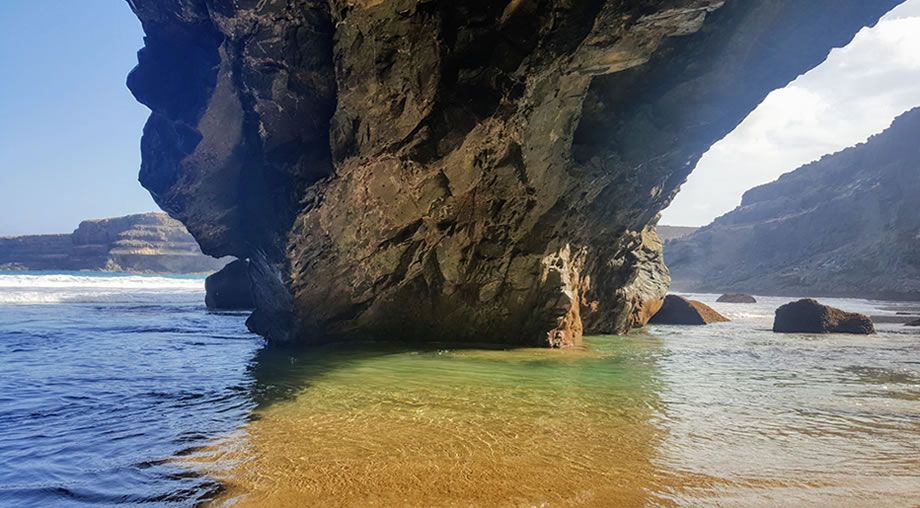
Los Molinos Beach
Puertito de Los Molinos: fishing tradition, lime kilns and coastal memory on the west coast of Fuerteventura.
An approach to the long history of a seafaring enclave
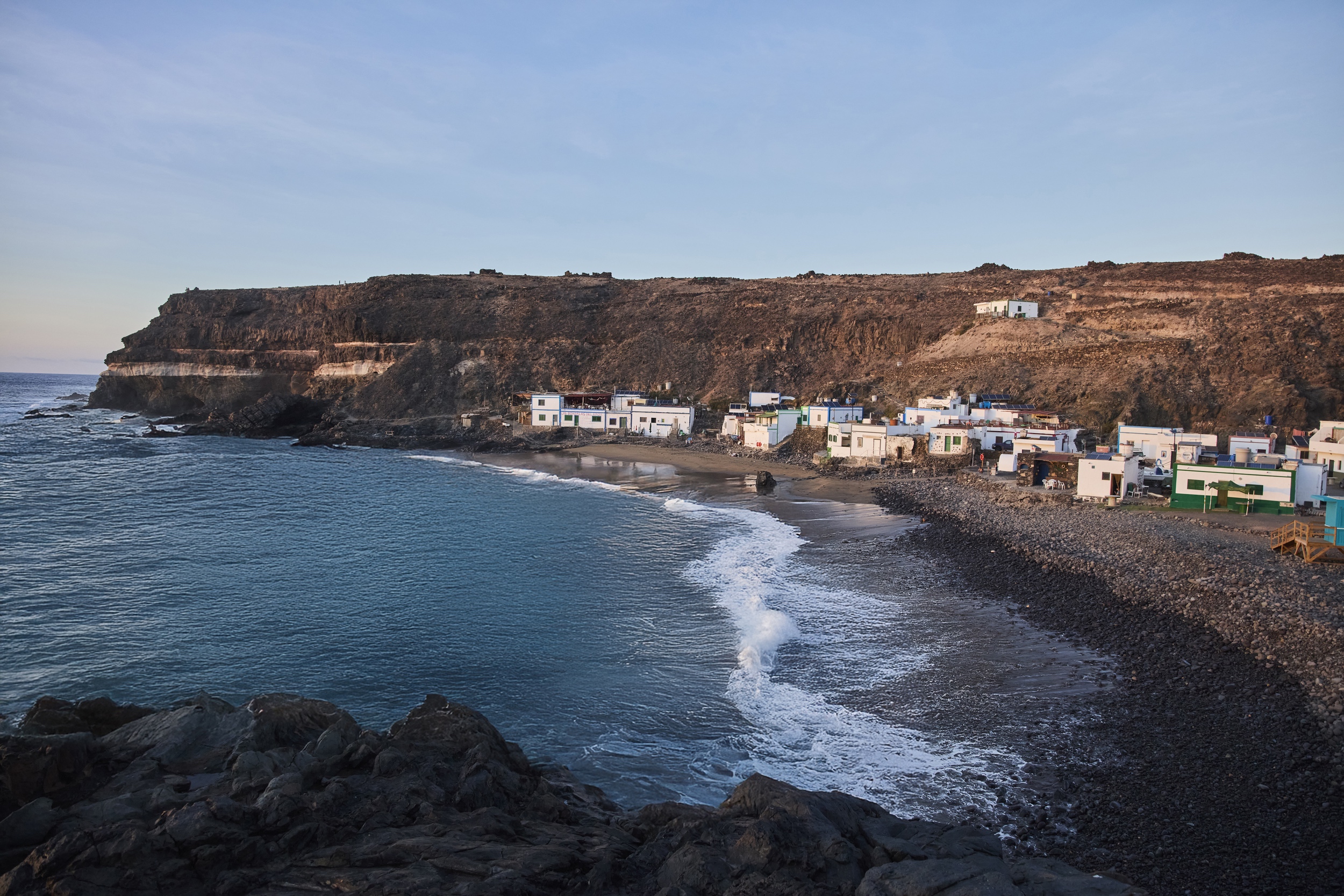
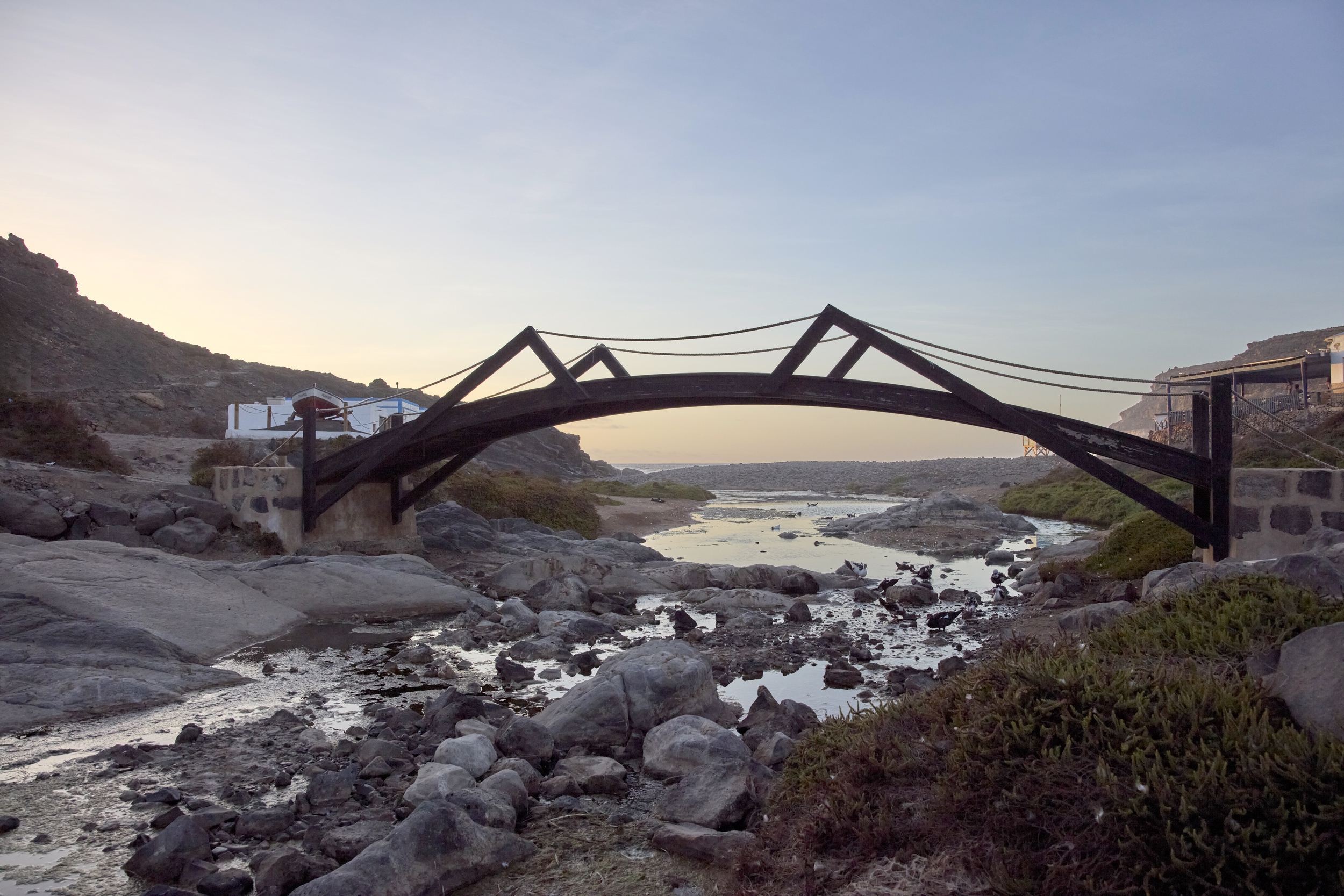
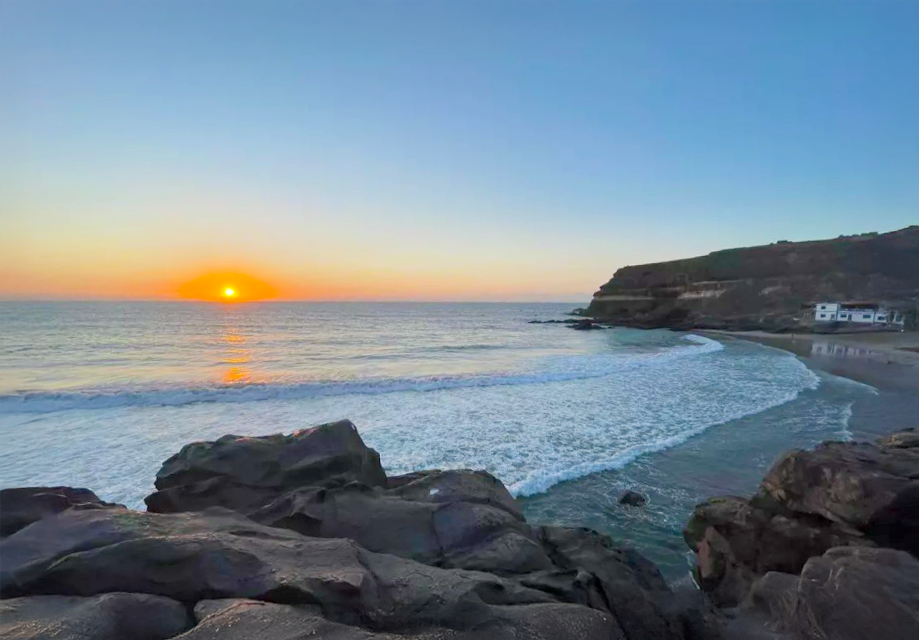
El Puertito de Los Molinos is a small and unique coastal hamlet belonging to the municipality of Puerto del Rosario, located on the west coast of Fuerteventura. This enclave, sheltered by high basaltic escarpments of more than 20 meters high, is one of the most beautiful corners of the island to enjoy the sunsets overlooking the sea. Its history, deeply linked to the fishing tradition, the lime industry and the use of coastal resources, is an essential chapter to understand the seafaring life and traditional economic activities of the coast of Majorca.
Unique geomorphology: a beach of hidden treasures
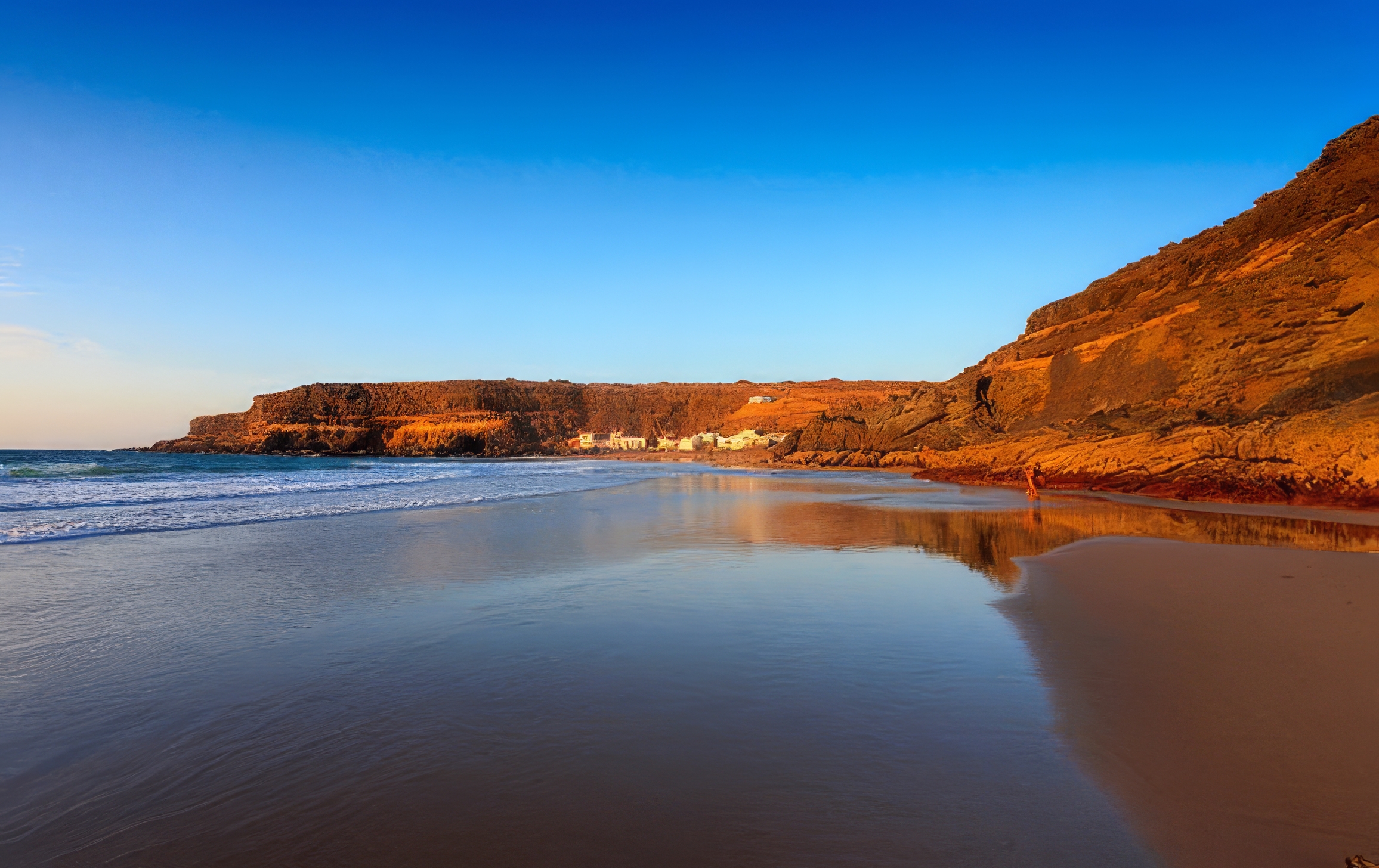
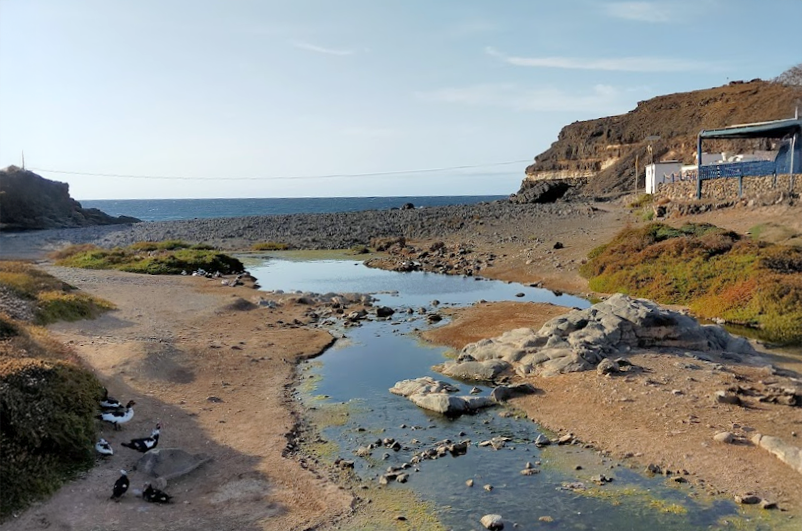
Los Molinos beach is located in a small cove sheltered by high basaltic escarpments. Its most unique feature is its dual nature: the first area of contact with the beach is a space of coarse pebbles (boulders) that covers much of it. However, when the tide goes out, nature shows its treasure: a spectacular beach of fine sand, ideal for a dip.
This phenomenon makes the enclave a place of constant transformation, where the sea reveals and conceals its secrets with the ebb and flow of the tides. The sea often lashes this part of the island with great force, making it very dangerous for swimming.
Las Mareas del Pino: a natural spectacle
The most fascinating phenomenon at this location occurs between September and October, when the spring tides—known in the Canary Islands as the Mareas del Pino—take place. During this time, Los Molinos Beach takes center stage on the island, attracting thousands of visitors who come to witness one of Fuerteventura’s most impressive natural spectacles.
During low tide, the shoreline recedes far enough to reveal spectacular caves that can be reached on foot. However, these caves are not always visible every year during the months of September and October, as their appearance depends on a delicate balance between tidal range, ocean currents, and the accumulation of sand inside them. Only when these natural conditions align do they become completely exposed and accessible on foot.
Los Molinos Beach also undergoes a remarkable seasonal transformation. During the winter, the landscape is dominated by boulders and rocky outcrops, as the strong waves wash away much of the sand. With the arrival of spring—and especially starting in May—the currents begin to carry sand back into the cove, where it gradually accumulates until the beach’s appearance changes. Later, between late summer and fall, the sea redistributes these sediments once more, exposing the rock formations and, when conditions are favorable, the sea caves. This natural cycle makes Los Molinos a living, ever-changing landscape, where each season offers a different view of the coastline.
This phenomenon makes the enclave a place of constant transformation, where the sea reveals and conceals its secrets with the ebb and flow of the tides. The caves remain hidden for much of the year and are once again covered at high tide, creating a natural cycle that has fascinated generations of Majoreros and visitors alike. The sea often lashes this part of the island with great force, so swimming can be very dangerous even when the beach appears calm.
Origins of the settlement: fishermen, refugees, and “ranchitos”
The history of Puertito de Los Molinos as an inhabited nucleus has its roots in the 18th century, linked to a geological event of great magnitude that transformed the neighboring island of Lanzarote.
The volcanic eruptions at Timanfaya, on Lanzarote, which began in 1730 and lasted for six years, drove thousands of people from their homes. Many of these displaced people were forced to emigrate not only to Fuerteventura but also to the rest of the world. In some notable cases, they helped found cities such as Montevideo, on the Río de la Plata, and San Antonio, in South Texas.
The movement of people and small boats among the various piers along the western coast of Fuerteventura led to the emergence of the first “ranchitos”: houses or shelters where people could take refuge during rough seas. El Puertito de Los Molinos was one of the settlements that emerged from this migratory process.
Fishing and shellfish farming
The presence of fishermen in Puertito de Los Molinos was consolidated throughout the 19th century. These fishermen used the enclave as a base for their activities, which included both inshore fishing and shellfishing. We have documented evidence of this activity thanks to the rescue that took place on August 31, 1901, when fisherman Ambrosio Santana, a resident of Puertito de Los Molinos, rescued shellfish gatherers Antonio and Luis Cabrera Llarena—aged 11 and 7, respectively—from the waters off the beach. The older boy was found dead, while the younger one was rescued alive. This tragic event also reveals the time of year when these activities took place and the name of one of the oldest residents of the small port.
El Puertito was, since time immemorial, a hamlet used by the fishermen of El Cotillo on their way to and from Morro Jable, being a strategic point in the coastal navigation of the west coast of Majorca.
The lime industry: kilns and exports
Along with the fishing tradition, Puertito de Los Molinos developed an important industrial activity linked to the production of lime. The Port of Los Molinos already appears in the cartography of the 18th century and, from the end of the 19th century, it was consolidated as an export point for lime stone, gypsum and derivatives.
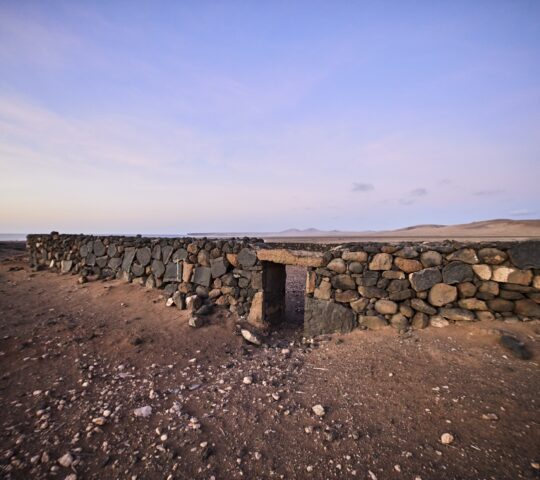
The lime kilns that can still be seen in the higher areas of the town date back to that period. These kilns, testimony of a traditional industry that reached its peak in the early twentieth century, are an ethnographic heritage of the first order. The lime produced in Los Molinos was fundamental for the traditional majorera construction, being used both for the mortar and for the characteristic whitewashing of the houses.
After its creation in 1913, the Fuerteventura Island Council claimed as its own the duties collected on the export and import of goods through the island’s ports and along its coastline. The small port of Los Molinos, through which significant quantities of limestone, gypsum, and their derivatives were exported, was subject to oversight by both the Casillas del Ángel City Council and the newly formed Island Council.
Commercial movement
Between 1912 and 1918 there were commercial movements of real estate on the beach of Los Molinos: houses, rooms and ovens were bought and sold. This activity shows the vitality of the hamlet and its economic importance in those years.
Gustav Winter’s visionary project: the wind power plant
One of the most fascinating episodes in the history of Los Molinos is the project promoted by the German Gustav Winter. In 1938, decades before the first power plant was built in Fuerteventura, Winter projected the construction of a wind power plant in Los Molinos.
The technical characteristics of the project were remarkably advanced for its time:
- Capacity: 500–650 kWh
- Backup power plant: with a capacity of 500 horsepower
This visionary project, which never came to fruition, highlights the energy potential of this stretch of Majorca’s coastline and the innovative capacity of certain stakeholders on the island during the interwar period. The name “Los Molinos” thus takes on a new meaning, linked not only to the possible existence of water mills in the past but also to the aspiration to harness the power of the wind to generate electricity.
Los Molinos dam: hydraulic infrastructure
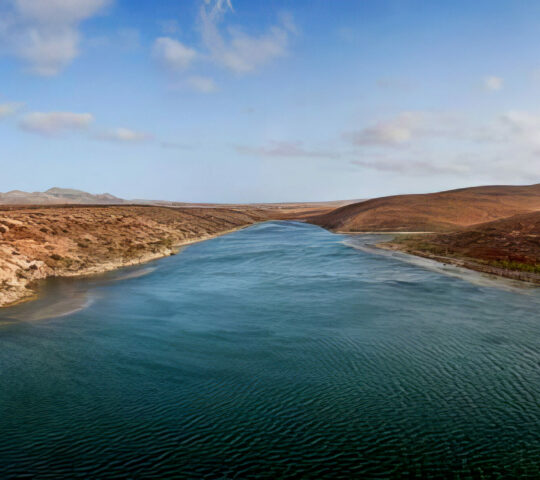
The area of Los Molinos was revitalized in the 20th century by the works promoted by the Economic Command of the Canary Islands, among which the construction of the Los Molinos dam stood out. This hydraulic infrastructure, intended for the retention of runoff water, allowed agricultural development in the nearby boards.
From 1950 onwards and during the 1960s, tomato plantations for export were added to the traditional economic activities, occupying the Los Opares and Los Molinos boards. These plantations were irrigated with water from the dam, constituting an important source of employment and economic activity in the region.
La Virgen del Carmen: patron saint festivities
If you want to know this town in all its splendor, you should visit it during its patron saint festivities in honor of the Virgen del Carmen, which are held around July 16. These festivities represent the most authentic expression of the seafaring identity of the little port.
The oratory dedicated to the Virgen del Carmen, although modest, represents the deep-rooted seafaring faith in this small enclave. The Virgen del Carmen is traditionally the patron saint of sailors, and her presence in the small port underlines the importance of fishing activity in the identity of the community.
Administrative assignment: from Casillas del Ángel to Puerto del Rosario.
Los Molinos belonged to the extinct municipality of Casillas del Ángel until 1926, when it was added to the municipality of Puerto de Cabras, today Puerto del Rosario.
Documentarily, since the merger of the municipalities of Puerto de Cabras and Casillas del Ángel, the new town council took care of registering the existing houses there for purely fiscal reasons. This inclusion in the tax records not only highlighted the very existence of the population center, but also recognized, in a way, the existence of private properties within the communal estate of Las Salinas and Jarugo.
A disputed recognition
The administrative circumstances of the little port were not always peaceful. In 1930, Ramón Peñate Castañeyra, mayor of Puerto de Cabras, was surprised when the Statistics Office wanted to exclude the little port under the pretext that nobody lived there. It was necessary to answer that the activities in that nucleus were sporadic, tacitly recognizing that they were conditioned by the state of the sea.
Infrastructure and services
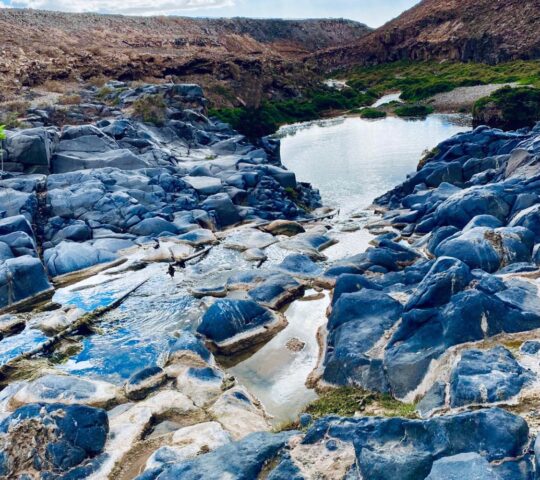
Despite these disputes, the Cabildo of Fuerteventura agreed to provide funds in the amount of 200 pesetas to fix the road that led from Tefía to Puerto de Los Molinos. Also in those years, the construction of a cistern or water tank was authorized to supply water to the coastal hamlet; rainwater, because the brackish water of the ravine was not drinkable at certain times of the year.
Historical continuity and territorial memory
El Puertito de Los Molinos represents a significant example of historical continuity on the west coast of Fuerteventura. From the eighteenth century fishermen’s refuge to the current seasonal farmhouse, this enclave has maintained a human presence linked to the sea and the resources of the territory.
The remains of the lime kilns bear witness to an industry that served as an economic engine for decades. The Virgen del Carmen festivities keep the seafaring tradition alive. The caves revealed during the Mareas del Pino tides remind us of the constant transformation of the coastal landscape. And Gustav Winter’s visionary project speaks to a desire for modernity that, although it never came to fruition, is now part of the town’s collective memory.
The valorization of this heritage -natural, ethnographic, industrial and immaterial- is not only a question of identity, but also an opportunity to build a future that integrates the legacy of the past with the needs of the present, offering visitors and residents a space where the memory of the sea and the land meet in a perpetual embrace.