La Molina de La Charca Museum
An emblem of the rural and cereal heritage of Puerto del Rosario.
The Museum of La Molina de La Charca is one of the most representative heritage elements of Puerto del Rosario and Fuerteventura, living testimony of the cereal history of the island and symbol of its agricultural identity. Its recovery has preserved an essential part of the majorera memory linked to the milling of grain and the production of gofio.
History and location
Built in the summer of 1878 by the Tenerife merchant Domingo Ángel Adrián, the mill was erected in a strategic area then located on the outskirts of Puerto Cabras (now Puerto del Rosario), at the confluence of the roads to Tetir and El Time. Its purpose was the milling of cereals such as rye, barley, oats and corn, essential for local food and the production of gofio, one of the most traditional products of the Canary Islands.
Architectural features
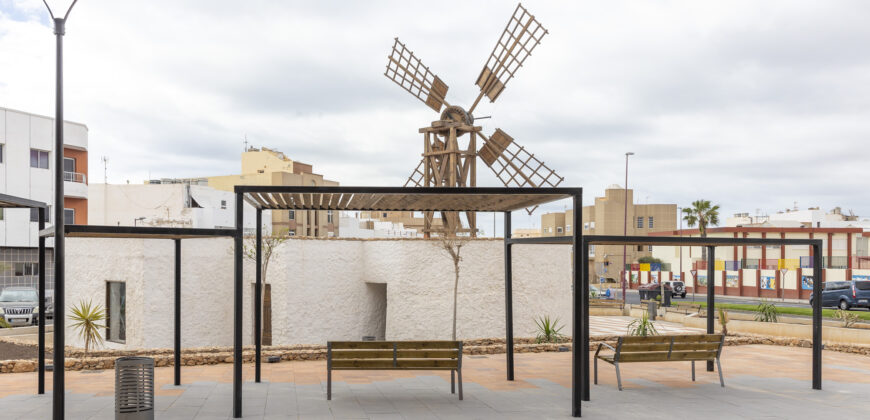
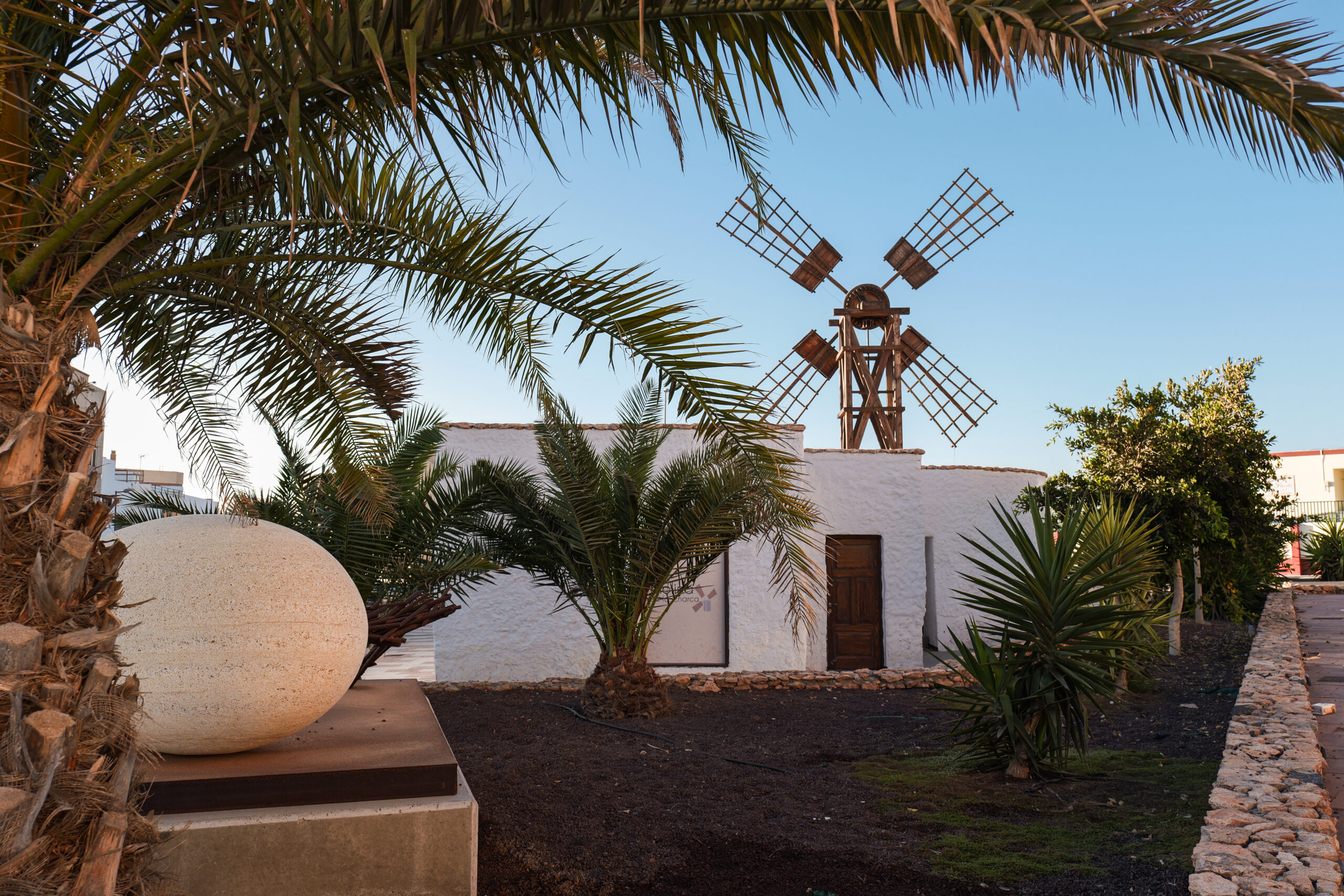
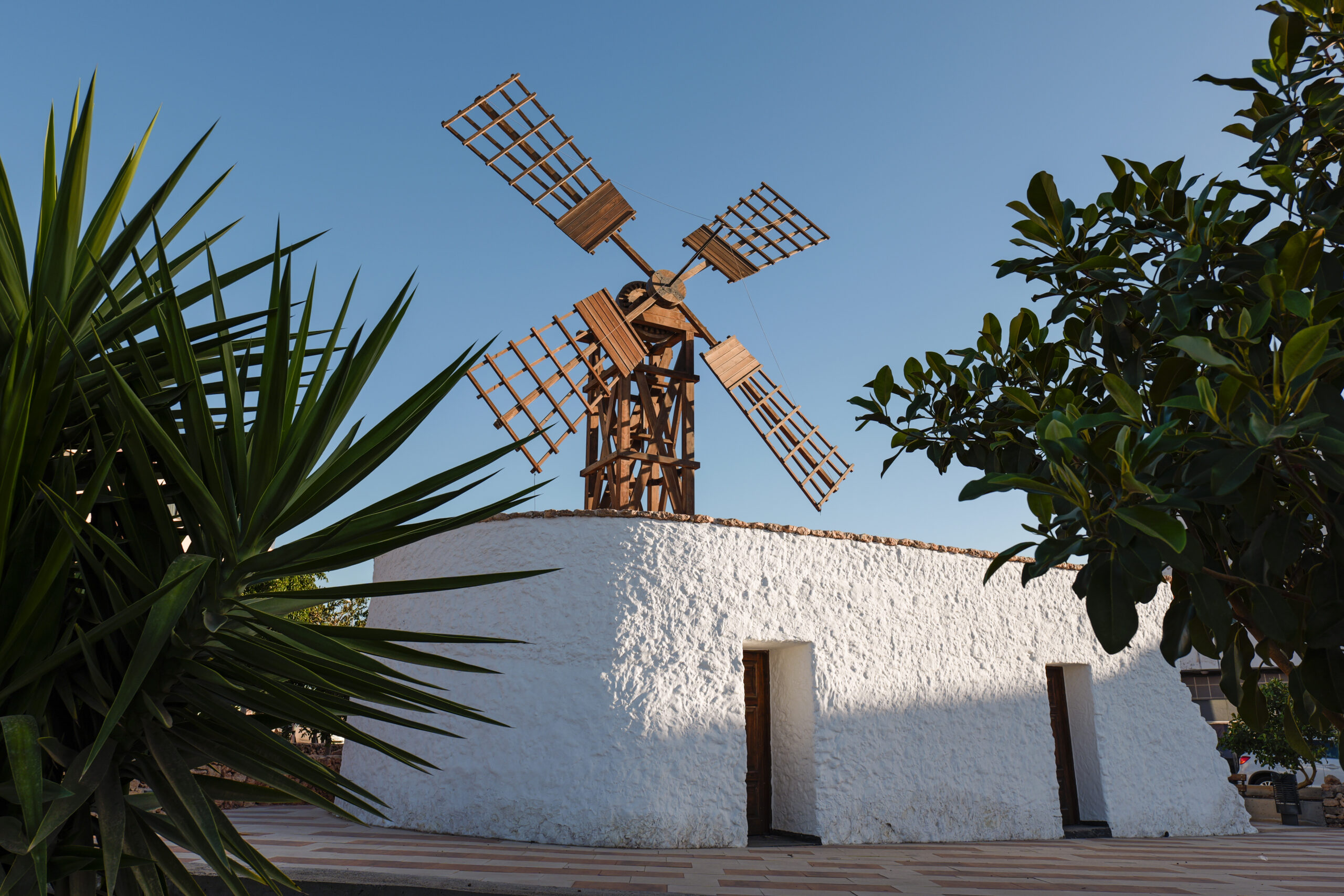
The Molina de La Charca is distinguished by its rectangular, single-story structure, crowned by a wooden tower that supported the milling mechanism and four blades of more than three meters. Its design, simpler and more portable than that of traditional mills, allowed the structure to be moved if necessary.
The original building was erected with stone masonry, mud, lime, sand and straw, following the construction techniques of the time. It had three distinct parts: the tower, the machinery and the annexes, which served as storage, living and office areas.
Restoration and heritage value
After ceasing its activity in the second third of the 20th century, the mill fell into disuse and deterioration. However, between 2021 and 2022, a comprehensive restoration was carried out that respected its original design and materials. Thanks to this intervention, the building has recovered its splendor and has become a symbol of the heritage recovery of the neighborhood of La Charca and Puerto del Rosario.
Today, the Molina de La Charca is one of the few preserved examples of Canary Island “molinas”, and its enhancement highlights the importance of preserving the agricultural and architectural heritage of the island.
Current use and visit
Currently, the space functions as a museum and cultural center open to the public, where you can learn about the traditional milling process, the tools used and the importance of cereals in the economy of Fuerteventura. In addition, its environment offers a journey through rural history and socio-economic transformations that marked the development of Fuerteventura.
Visiting the Molina de La Charca is an opportunity to discover the popular architecture, the cereal culture and the constructive ingenuity that characterized the ancient inhabitants of the island.
La Molina Square (La Charca)
Industrial and agricultural heritage of Puerto del Rosario
Today it is a museum. But before it was many other things.
It used to be a wasteland on the outskirts of Puerto Cabras. Before it was the confluence of two roads: one to Tetir, the other to El Time. Before it was permission for its implementation, requested to the consistory in mid-August 1878. Before that, it was the idea of a merchant from Tenerife named Domingo Ángel Adrián.
What you see now
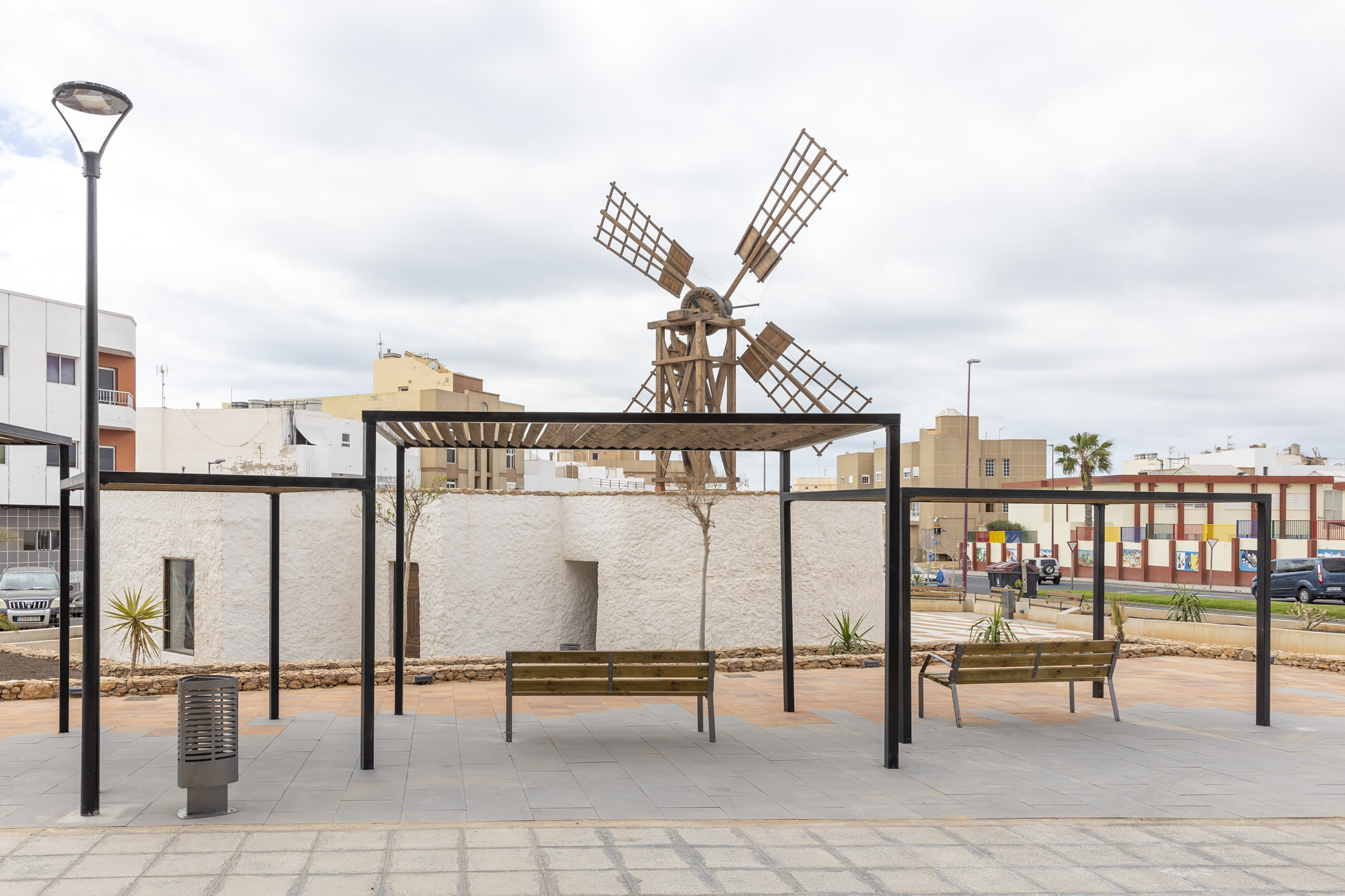
La Molina de La Charca has been restored since September 2025. Its walls are made of masonry: medium stone with mortar of mud, lime, sand and straw. It has four blades of just over three meters each. The original tower disappeared long ago; the one we see today is a restoration.
The Plaza de La Molina is today a public space, a free museum and a fragment of industrial and agricultural memory. The wind no longer moves its blades, but the building is still standing and, inside, a story is told that for decades nourished this island.
Inside, a single floor with several rooms. The central one is the largest. The milling machinery was there: two millstones, the hopper and the chute. The miller worked there. Today, the whole process is explained, turning the space into a museum where the milling, the tools and the life of those who lived from the cereal are interpreted.
A unique plant
What makes this mill special is its original shape. It had a circular structure on the west side, where the machinery was located, and attached to it another rectangular structure that served as a dwelling and office. At the rear, a small room was used as a warehouse. The restoration has respected this original layout.
What he milled and what he sold
According to the Industrial and Commerce Contribution of 1897-1898, this mill was dedicated “exclusively to the milling of rye, barley, oats and corn”. But Domingo Ángel Adrián did not live only from this activity. He also ran a store with oil, vinegar and soap, and owned several lime kilns.
Until when did it work
The mill was active at least until the second third of the 20th century. At that time it belonged to Domingo Ruiz Cedrés. Then it was abandoned.
At the beginning of the 21st century, following the resolution of an immatriculation file for the land, the restoration of the site was considered. Work began in July 2021 and was completed in September 2025.
Context: mills and mills
Fuerteventura had a prosperous cereal past. Until the eighteenth century it was milled on a small scale, with hand mills and tahonas. Later came the large tower mills or “male mills”: circular, three levels and truncated cone shape.
Windmills appeared in La Palma in the second half of the 19th century, invented by Isidoro Ortega Sánchez. They are rectangular in shape, with a single height and between four and twelve blades, always in an even number. Their main advantage was that they combined milling and grain handling in the same space, without the need for the miller to go up and down stairs. In addition, they were easier to build and, in theory, transportable.
In Fuerteventura, local carpenters and craftsmen adapted the Ortega system to the wind conditions and the materials available on the island. This is how the majoreras windmills were born. La Charca is one of them and, most likely, one of the oldest in Fuerteventura.