Casillas del Angel
Casillas del Ángel: history of a majorero town with a municipal past and a living heritage
Casillas del Angel is a town whose origin dates back to the territorial organization after the European conquest of Fuerteventura, initiated by Jean de Béthencourt and Gadifer de La Salle in the early fifteenth century. Although the area was previously used for grazing by the first inhabitants of the island, the mahos, it would not be until after the conquest when they began to form small rural settlements linked mainly to goat farming and subsistence agriculture, within the system of manors established.
The settlement of Casillas del Angel was first consolidated around a settlement of modest houses located in a place of farmland and gullies along roads that connected the various payments of the interior. Later, more stately houses would appear that today form part of the architectural heritage of the municipality. This nucleus was initially known as “Las Casillas”.
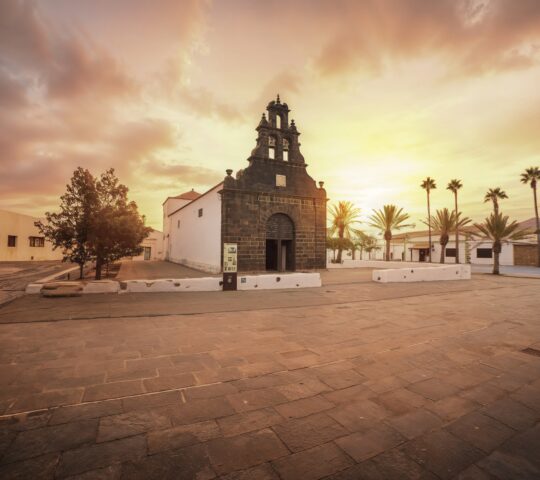
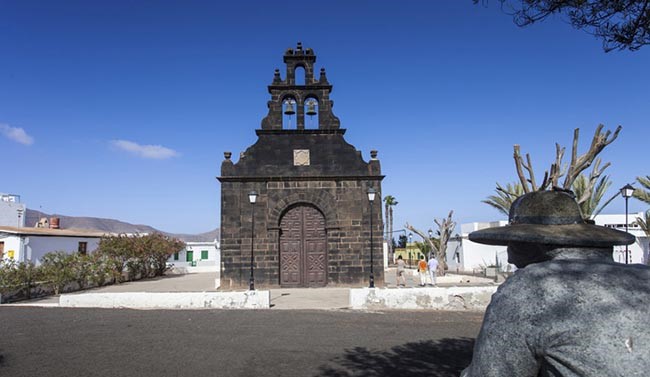
Its current name, Casillas del Ángel, comes from the construction of a small hermitage dedicated to the Santo Ángel de la Guarda, erected in the 17th century thanks to the donation of Doña Ana Rodríguez Sanabria, which still preserves its original image. This temple, together with the later and larger Parish Church of Santa Ana (built between 1730 and 1781), turned the village into an important spiritual center in the north of the island for centuries, to which inhabitants from other areas came for religious celebrations.
However, the real historical significance of Casillas del Angel lies in its administrative role. In 1790 it was established as a parish and, in 1812, with the formation of its first municipal corporation, it became one of the historic municipalities of Fuerteventura. Its jurisdiction was one of the largest on the island, covering numerous payments and hamlets such as La Ampuyenta, Almácigo, Majadillas, Llanos de la Concepción or Tao, among others.
Its territory extended along the southeast (bordering Antigua) and west (bordering Betancuria and La Oliva), even reaching the east and west coasts, with the ports of Tegurame and Los Molinos.
This broad demarcation not only reflects its geographic and political importance, but also the legacy of aboriginal territorial organization, especially visible in the persistence of the mancomunal zone on the west coast. These lands of collective use, heirs of the mahos, have survived to the present day as communal grazing areas.
It is precisely in these places where the traditional “apañadas” are held, a livestock practice of aboriginal origin that consists of the collective herding and gathering of goats in a semi-wild state. The apañadas are not only a livestock management technique, but a true living testimony of the Maho culture, a community ritual that has survived centuries of history and continues to bring together shepherds and neighbors, keeping alive the ancestral memory of the territory and its shared use.
The status of independent municipality was maintained for more than a century, a period in which the locality preserved a markedly agrarian and livestock economy and way of life, deeply linked to practices such as the “apañadas”. Life revolved around goat herding, the artisanal production of majorero cheese, cultivation using the traditional system of gavias to capture rainwater and a rural architecture of low whitewashed stone houses, along with some more stately multi-storey houses, among which the Rugama house stands out.
However, recurrent droughts and emigration, especially during the 19th and 20th centuries, limited its demographic and economic growth.
In 1849, in the fourteenth volume of the Diccionario geográfico-estadístico de España y sus posesiones de Ultramar by Pascual Madoz, the place is described as a fertile valley that enjoys good ventilation and a healthy climate. It had a school of first letters attended by 17 disciples and the parish church of Santa Ana. According to the work, the territory produced wheat, barley, barrilla, potatoes and some cochineal, whose harvest could be increased; raised sheep and goats, and practiced hunting and fishing of some kinds. The industry and commerce were reduced to the weaving of woolen fabrics with thread and the exchange of some of its productions.
The First Wayside Shrine: Guardian Angel
Before the construction of the present parish, the spiritual life of the first settlers of “Casillas” and its surroundings was organized around an older hermitage: the Ermita del Ángel de la Guarda (Hermitage of the Guardian Angel).
This primitive temple, which today is preserved next to the current cemetery of Casillas del Ángel, was for years the center of devotion of the farmers and ranchers of the region, who went to it to entrust their crops and ask for protection. This hermitage represents the very origins of the parish organization of the territory, before Casillas del Ángel acquired the ecclesiastical relevance it would later attain.
The church of Santa Ana: architecture and historical-cultural legacy
The Church of Santa Ana is a temple of the eighteenth century that emerged in the context of economic and demographic expansion that Fuerteventura lived in that century. Its construction was driven by the neighbors themselves and was part of a process of ecclesiastical reorganization on the island, driven by the Parish Restructuring Plan of 1750, which divided the territory into four parishes, Santa Ana being one of them.
Although in 1744 the works were already well advanced, they were not completed until 1781, according to a plaque on its façade. Towards the end of the century, the building underwent an extension and renovation.
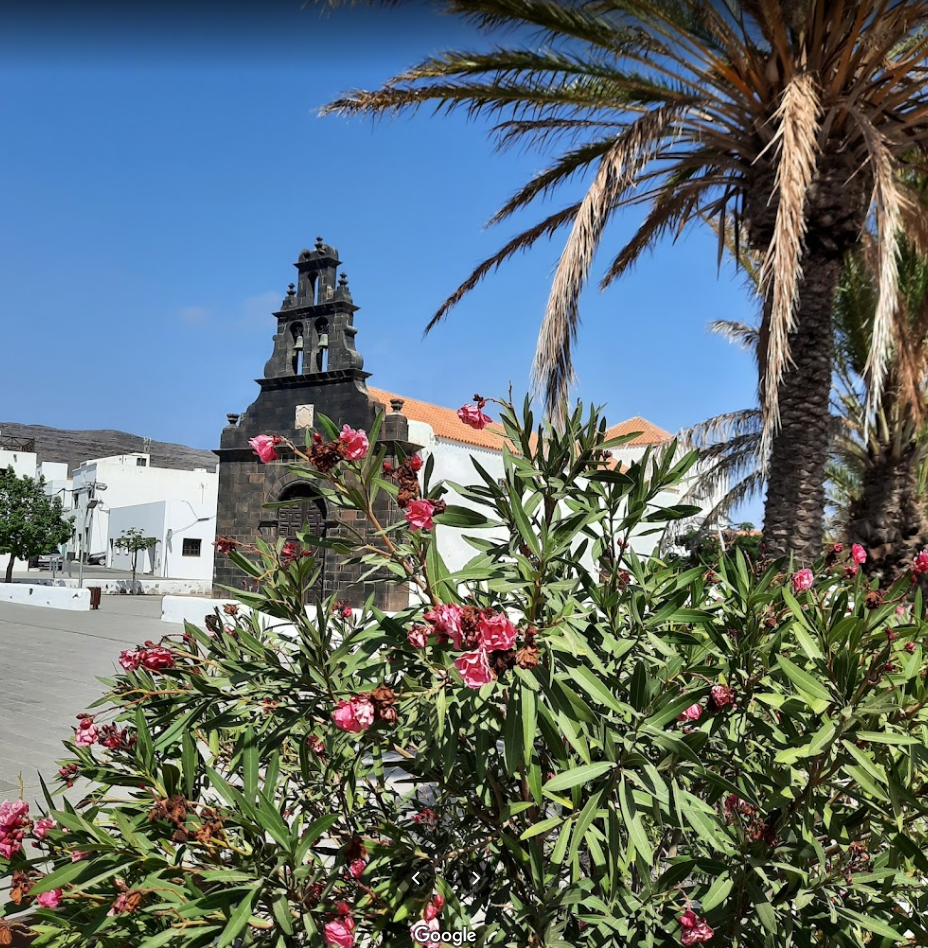
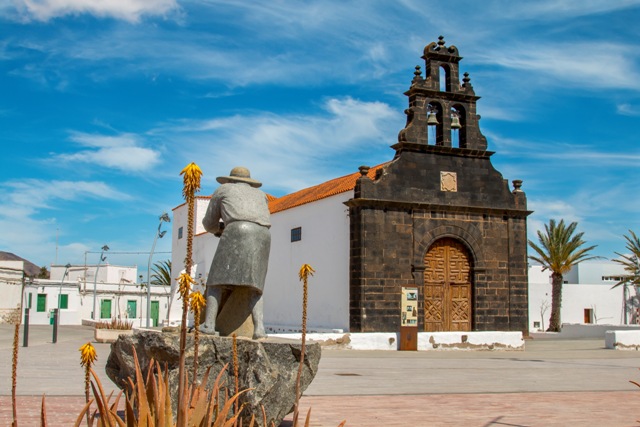
Externally it emphasizes its facade of black stonework, with a door topped with a semicircular arch. The nave is elongated, with a gabled tile roof, while the presbytery has a four-sided roof.
Inside, the wooden ceiling rests on a decorated sill and has paired suspenders decorated with geometric motifs. The presbytery is covered with an octagonal structure on pendentives, adorned with a central pinjante. Among the goods that it houses, it emphasizes a valuable sculptural group of Santa Ana and the Virgin.
In addition to its architectural value, the temple has historical relevance for being the place where Fray Andresito, one of the most beloved figures of the island, was baptized on January 18, 1800. Finally, the church was declared an Asset of Cultural Interest with the category of monument on June 21, 1991.
The tradition of bell ringers
Among the most deeply rooted traditions of Casillas del Ángel is the figure of the bell ringers, a craft and an art that has passed from generation to generation and that is part of the sound identity of the town.
For decades, the peals and tolls of bells have marked the pulse of daily life: calling to mass in the Church of Santa Ana, announcing important events, guiding processions or accompanying moments of mourning and celebration.
Each ringing had its own meaning, a language that the bell ringers of the town mastered and that made the bells “speak”.
Newspaper articles and the oral memory of the neighbors have rescued the importance of these traditional chimes, which turned the bell tower of Santa Ana into a voice capable of congregating an entire community. This tradition, today valued as intangible heritage, connects the present with centuries of living history.
La Casa de los Rugama: stately hacienda in the heart of Fuerteventura
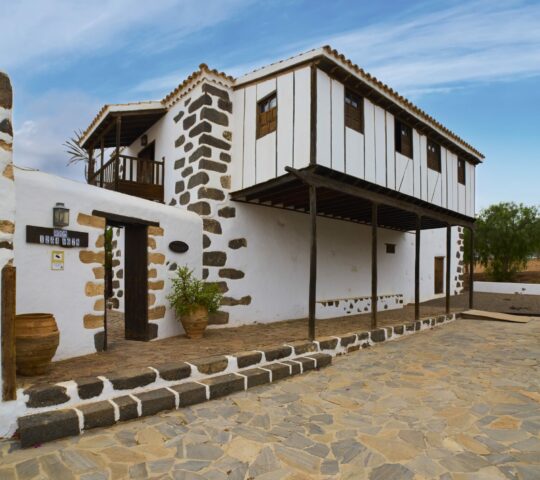
At the entrance of Casillas del Ángel stands the Casa de los Rugama, one of the most representative examples of traditional Majorero architecture of aristocratic character.
This emblematic building belonged to one of the most influential families in the area, among its members Lázaro Rugama Nieves, first mayor of the independent municipality of Tetir in 1834, and Francisco Rugama, known for his confrontation with Dr. Mena.
The architectural complex is a magnificent example of an 18th century rural hacienda, where, in addition to the main building, the surrounding elements are of special relevance: straw bins, threshing floors, water troughs, water troughs, drainpipes and cisterns.
All this infrastructure reflects an agrarian society focused on cereal crops and completely dependent on rainfall, which explains the sophisticated system designed to make the most of rainwater.
The main house is organized around a courtyard closed on the south, in the shape of an L. The north and east wings, the most noble, have two floors topped with tile roofs to two and four waters, connected by a covered corridor typical of Canarian architecture. The balcony is another of its most characteristic elements, faithful to the architectural tradition of the archipelago.
The history of this property has gone through various vicissitudes since the seventeenth century. In the second half of the twentieth century came to be in a state of neglect, even serving as a goat pen when the Cabildo of Fuerteventura acquired it from the Diocese of the Canary Islands in 1998. Despite the deterioration of its roofs and walls, technical studies confirmed its viability for a recovery that would preserve this valuable island heritage.
Casillas del Ángel ceased to be a municipality in 1926.
In 1926, an administrative reorganization marked a turning point in its history: Casillas del Ángel was dissolved as a municipality and its territory became part of the former municipality of Puerto Cabras, today Puerto del Rosario.
Although it lost its political autonomy, the town has managed to preserve with remarkable integrity its historical heritage, cultural identity and traditions. Among them are the Fiestas de Santa Ana in July, one of the oldest devotions of the island, which combine religious events with popular celebrations, as well as the festivities of the Holy Angel in late February and early March.
Today, Casillas del Angel is presented as a quiet village integrated in Puerto del Rosario, which treasures among its streets the trace of a past in which it was an important religious center and a key municipality in the articulation of the interior of Majorero.
Its well-preserved historical-religious heritage, its rural landscape and the vestiges of its traditional architecture are silent witnesses of a time when this town was one of the vital centers of Fuerteventura.
But above all, Casillas del Angel keeps in its territorial memory and practices such as apañadas held in their coastal mancomunes a direct and tangible link with the culture of the first inhabitants of the island, the mahos, making this town an active guardian of the deepest identity of Fuerteventura.