





Tetir
TETIR: HISTORY, TRADITION AND MEMORY AT THE HEART OF FUERTEVENTURA
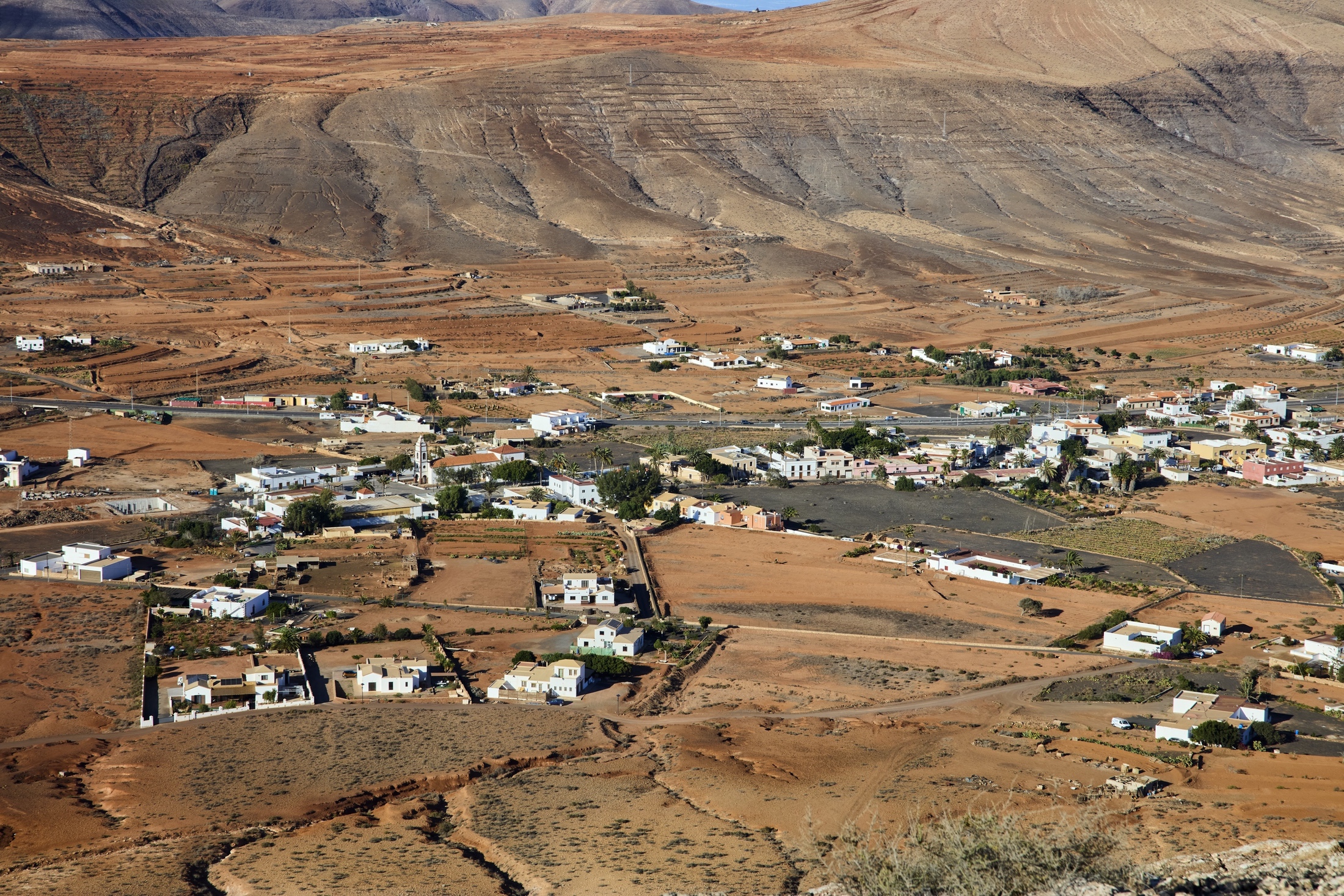
Tetir, in the heart of Fuerteventura, is much more than just a village; it is a silent witness of the evolution of the island. Its history dates back to the time of the mahos, the original settlers, whose legacy lives on in the very name of the place, a place name with possible pre-Hispanic roots whose exact meaning is still under study. However, the urban nucleus that we know today began to be forged in the 18th century, growing around the fertile plain that shelters it.
For generations, life in Tetir has beaten to the rhythm of agriculture. The clever construction of gavias, a system to capture rainwater, transformed the landscape and turned it into a granary for the center-north of the island. This ingenuity to take advantage of such a scarce resource is evidence of human adaptation to an arid environment.
The importance of the town grew so much that, in 1812, it became an independent municipality, managing a vast territory that included the then small Puerto de Cabras (today Puerto del Rosario), as well as other villages such as La Matilla, El Time or Guisguey. This administrative relevance was accompanied by its role as a spiritual center.
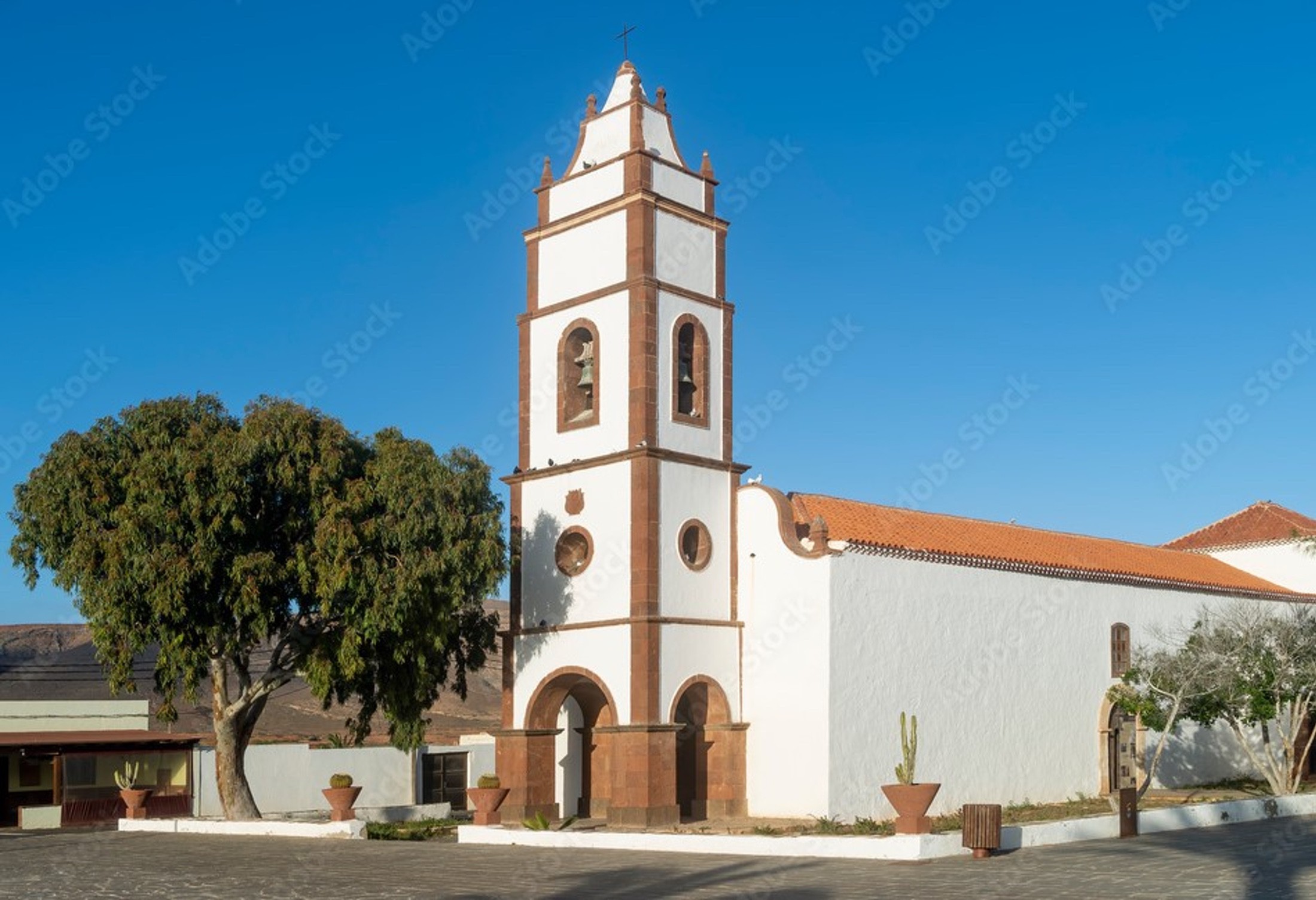
The heart of Tetir is undoubtedly the Church of Santo Domingo de Guzmán. Although it began to be built around 1750 and obtained the rank of parish in 1777, its construction lasted until the late nineteenth century, reflecting the slow but steady growth of the community. Its image, with the free-standing bell tower or belfry that was added in 1880, is an emblem of the municipality, also recognized as an Asset of Cultural Interest.
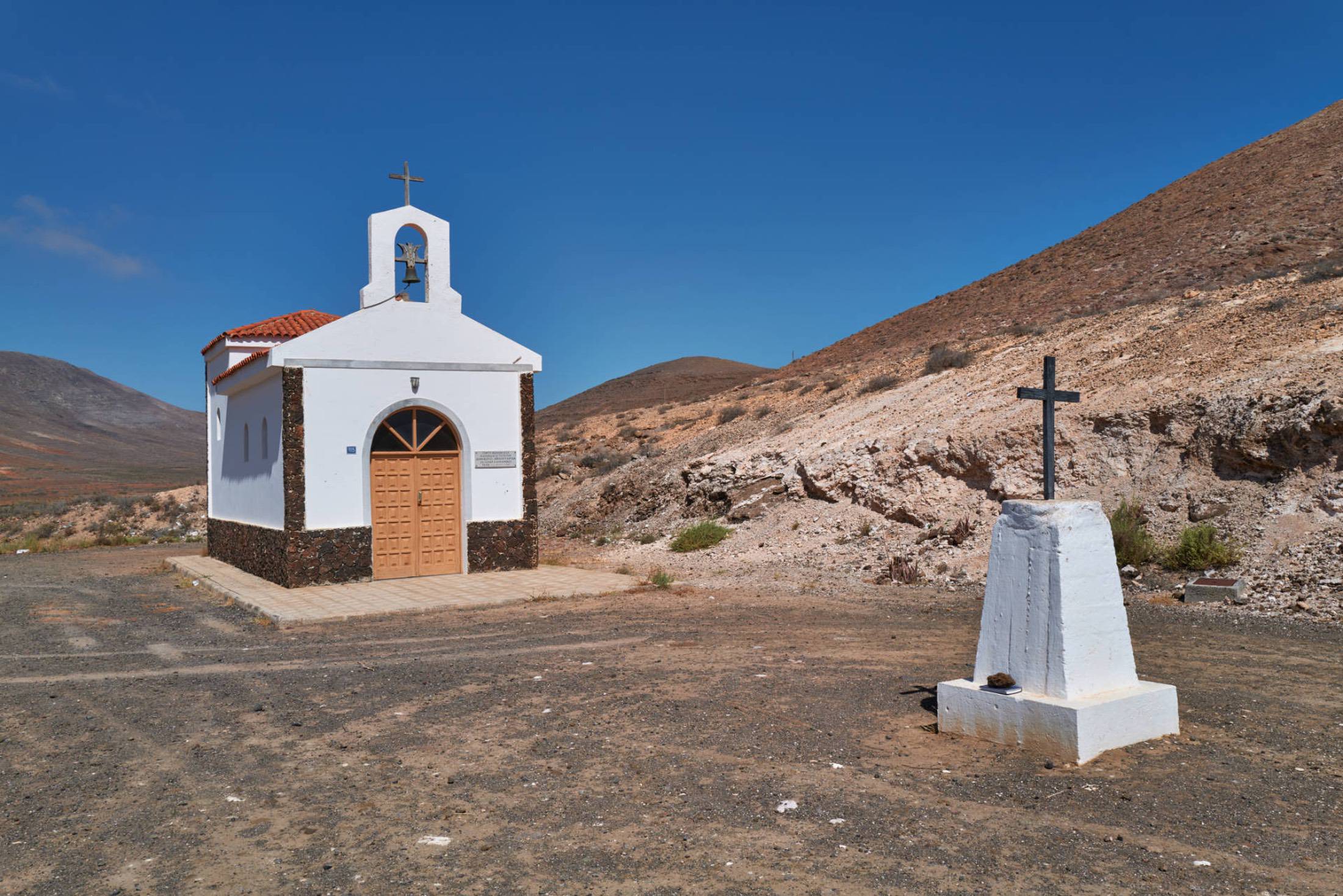
Not far away, in the Sargenta Valley, is the small hermitage of San Andrés. This place is the epicenter of one of the most deeply rooted traditions: every November 30, the neighbors participate in a pilgrimage in honor of San Andrés, a celebration that mixes faith and ancestral rituals to ask for rain, connecting the present with the ancient rogations of the Majoreros.
The administrative decline of Tetir began with the rise of Puerto Cabras. In 1835, the port was segregated to form its own municipality, a process that culminated in 1925, when Tetir lost its autonomy and was definitively integrated into the municipality of Puerto del Rosario. In spite of this, the town was able to preserve its identity.
Today, that identity beats strongly thanks to its cultural fabric, led by the Agrupación Folclórica de Tetir. Founded in the early seventies, this group has become the main bastion of the island’s traditions. For more than five decades they have researched and disseminated the music, dances, costumes and popular customs, performing all over the islands and outside the archipelago. They are the architects of the prestigious Encuentro de Solistas and the aforementioned Romería de San Andrés, events that unite the people and attract visitors.
The Geographical-Statistical Dictionary of Spain and its overseas possessions, by Pascual Madoz, defined at the end of the XIX century La Vega de Tetir as a municipality on the island of Fuerteventura with three very fertile valleys, formed by four mountain ranges or knives, as the natives call it, for which reason it is poorly ventilated, which makes its climate unhealthy. The products of its agriculture are wheat, barley, barrilla, millet, potatoes, chickpeas, legumes and vegetables; very good vineyards, fig trees, pear trees, peach trees, almond trees and pomegranate trees are raised, being the most abundant the nopales. The natural products are cosco and pasture grass, with which the sheep, goats, camel, cattle, horses and asses are raised and maintained.
THE HERMITAGE OF SAN ANDRÉS, LIVING CULTURAL HERITAGE OF TETIR
The Ermita de San Andrés, located in the Sargenta Valley in Tetir, is a symbol of the agricultural tradition of Fuerteventura. Its history is divided into two stages: an original temple of the seventeenth century and the present building, donated in the late twentieth century.
Origin and pattern of rainfall
The first temple was built by the settlers of Tetir between 1650 and 1652. Its origin dates back to 1609, when the Island Council named San Andrés patron saint of farmers and rain advocate, a decision made by lottery. This original hermitage lasted until the middle of the 18th century, when it collapsed.
Present hermitage
The modern building was donated by Juan Berriel Jordán to the parish of Santo Domingo de Guzmán on November 30, 1989, as a plaque on its façade reminds us.
Traditions and rituals
Every November 30, hundreds of people gather in the Vega de Tetir. A procession takes place where the saint is prayed to intercede to bring rain to the fields. There is a popular saying that reflects this need:
“If it doesn’t rain for Santa Catalina (November 25) or San Andres (November 30), it’s bad.”
Historical rituals
In the past, in times of drought, farmers used to perform a unique ritual: they would carry the image of the saint and “judge” him, threatening to throw him (“enriscarlo”) down a mountain if he did not send the much-desired rain.
Patronage of the Local Police
Since 1985, San Andrés is also the patron saint of the Fuerteventura Local Police. The celebration includes official acts and tributes to the agents.
THE CHURCH OF SANTO DOMINGO DE GUZMÁN, A HISTORIC MUNICIPAL PARISH CHURCH
The Church of Santo Domingo de Guzmán is the main catholic temple of Tetir, whose construction responds to the need for a larger worship space than the small hermitage of San Andrés. Its origin dates back to 1745, when the neighbors signed its endowment, starting the works around 1750 and finishing at the end of the XIX century.
In 1777, the Cathedral Chapter granted it the rank of parish, which led to the foundation of three brotherhoods: that of the Blessed Sacrament, that of the Blessed Sacrament, and that of the Holy Sacrament. Confraternity of Our Lady of the Rosary and that of Las Benditas Ánimas. Its jurisdiction extended to the pagos of Guisguey, El Time, La Matilla, and later to La Asomada, Los Estancos and Puerto Cabras.
Architectural description
The building has a single nave with a three-slope tile roof and a four-slope elevated presbytery. It has two entrances: a semicircular arch in the side wall and a main doorway with a bell tower added in 1880.
The interior is covered with a wooden armor decorated with suspenders of lacery and houses the choir at the foot and a polychrome pulpit with Eucharistic motifs. The main altarpiece, of baroque style from the middle of the 18th century, has niches separated by stipes and Solomonic columns.
Artistic heritage
The church preserves a valuable group of sculptures and paintings from the 18th and 19th centuries:
– San Juan Bautista
– Our Lady of Sorrows
– Saint Andrew
– Saint Anthony with Child
– Saint Joseph with Child
– The Immaculate Conception
– Christ on the Cross (18th century)
– Our Lady of the Rosary
– St. Catherine (dressed as a Dominican)
– St. Dominic (carrying the model of the temple)