

Church of Santo Domingo de Guzmán
The Church-Church of Santo Domingo de Guzman is located in the village of Tetir, within the municipality of Puerto del Rosario, and is one of the most important temples of the interior of Fuerteventura for its historical, architectural and heritage dimension.
After the ecclesiastical decentralization of the island in the early eighteenth century and the visit of Bishop Guillén in the 1740s, the construction, restoration and expansion of numerous majoreras hermitages was promoted. At that time, Tetir lacked a church with sufficient capacity to serve the faithful of the Vega, since it only had the small chapel of San Andrés, located in the valley of La Sargenta. This need led the neighbors to promote a new temple.
In 1745, the inhabitants of Tetir signed the deed of endowment of Santo Domingo de Guzmán. The works began around 1750 and lasted for decades, finishing its construction at the end of the 19th century. In 1777, the Cathedral Chapter granted the temple the category of parish, which was a milestone in the religious organization of the area. From that moment on, three lay brotherhoods were founded, coordinated by a priest: the Brotherhood of the Blessed Sacrament, the Brotherhood of Our Lady of the Rosary and the Brotherhood of the Blessed Souls of Purgatory. The new curato also took care of the villages of Guisguey, El Time and La Matilla, later incorporating La Asomada, Los Estancos and Puerto Cabras.
From the architectural point of view, the temple is configured in a single nave, with a three-sided roof and exposed tile on the exterior. The presbytery, clearly differentiated in height, has a hipped roof. The sacristy and the baptismal room are attached to the south wall. The church has two entrances: a lateral one, located in the wall of the epistle, made in clear stonework and finished off with a semicircular arch, and another at the foot of the church, corresponding to the main doorway.
In 1880 the bell portico of the main façade was built and, a few years later, in 1883, the singular bell tower was erected, visible from a great distance among the surrounding plains. This tower is composed of a succession of cubic bodies that decrease in size as they gain height, becoming one of the most characteristic elements of the landscape of Tetir.
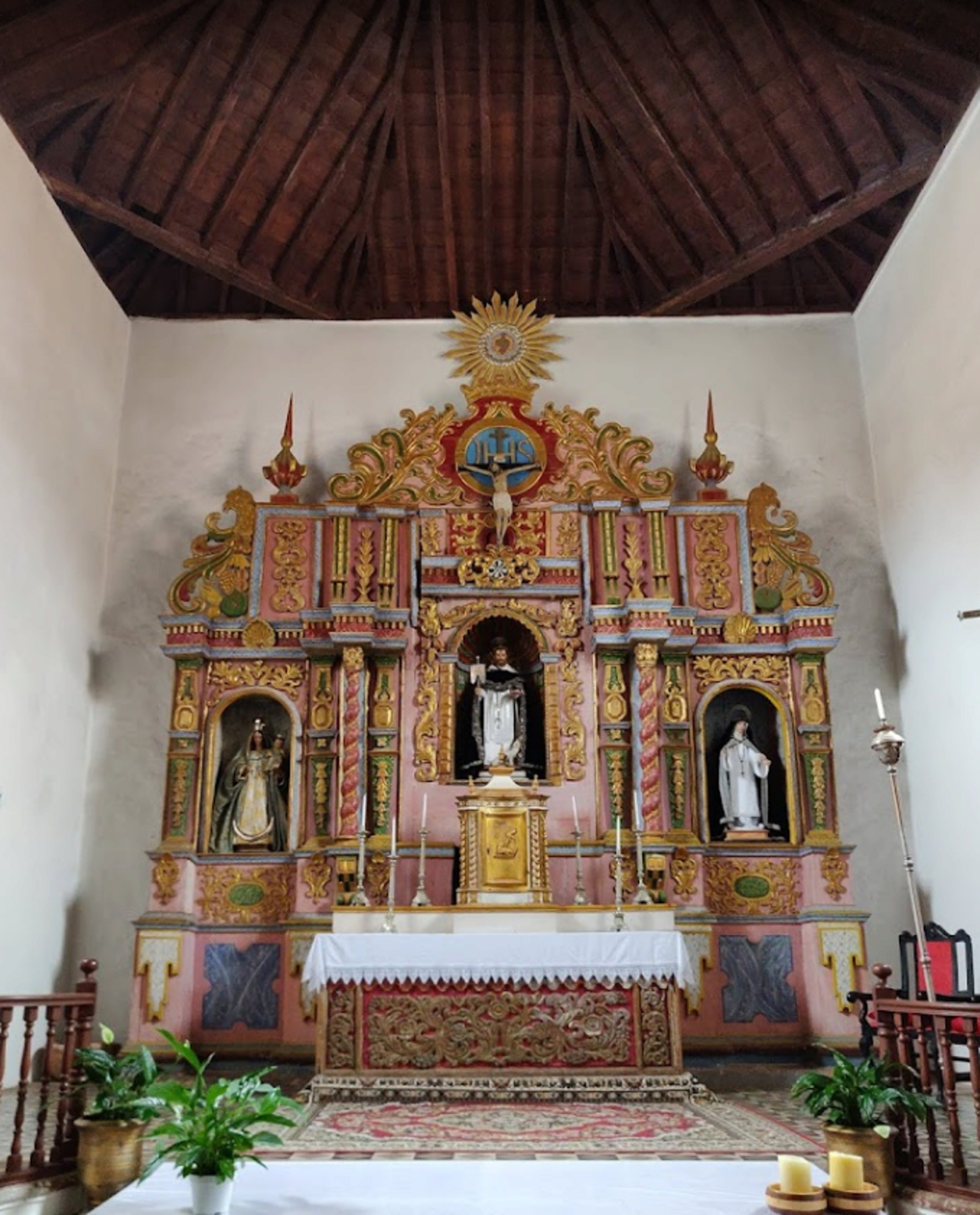
The interior of the temple is covered with a simple wooden framework, reinforced with paired suspenders decorated with geometric motifs of lacework. In the lateral walls there are several niches destined to receive devotional images. At the foot of the church is the choir, made of wood and accessible by a spiral staircase. The pulpit, attached to the wall of the gospel, is made of polychrome wood and decorated with symbols of the Eucharist.
The main altarpiece, of simple workmanship, is of polychrome and gilded wood and responds to a baroque design of the middle of the XVIII century. It is structured in a single body with three niches separated by stipites and two Solomonic columns arranged at different levels.
The temple houses a rich sculptural heritage, among which stand out 18th century images such as Saint John the Baptist, Our Lady of Sorrows, Saint Andrew, Saint Anthony with the Child, Saint Joseph with the Child, the Immaculate Conception, Christ on the Cross, Our Lady of the Rosary, Saint Catherine and the central image of Saint Dominic of Guzman, represented with the standard, the model of the church and the dog with the torch, symbol of the Dominican order.
It also preserves an important group of pictorial works, such as the Painting of the Mysteries of the Rosary, painted in mixed tempera on canvas; the Painting of Souls, a large format oil painting attributed to the Canarian painter Juan Bautista Bolaños, made between 1785 and 1792; the paintings of Santa Francisca Romana and Santas Justa and Rufina; and remains of mural painting discovered in 1984, executed in tempera on lime and sand mortar next to the main arch.
A particularly recommended time to visit the church is during the celebration of the Tetir Craft Market, which takes place in the vicinity, although the temple reaches its greatest splendor during the patron saint festivities, held in the first week of August, being August 4 its main day. In addition, from this enclave depart the PR-FV 15 and PR-FV 15.1 trails, which allow you to travel through traditional agricultural landscapes, full of crops and gullies.
The Church-Church of Santo Domingo de Guzman is today a fundamental element to understand the religious, social and cultural history of Tetir and the interior of Fuerteventura, and an essential stop within the heritage routes of the municipality of Puerto del Rosario.